
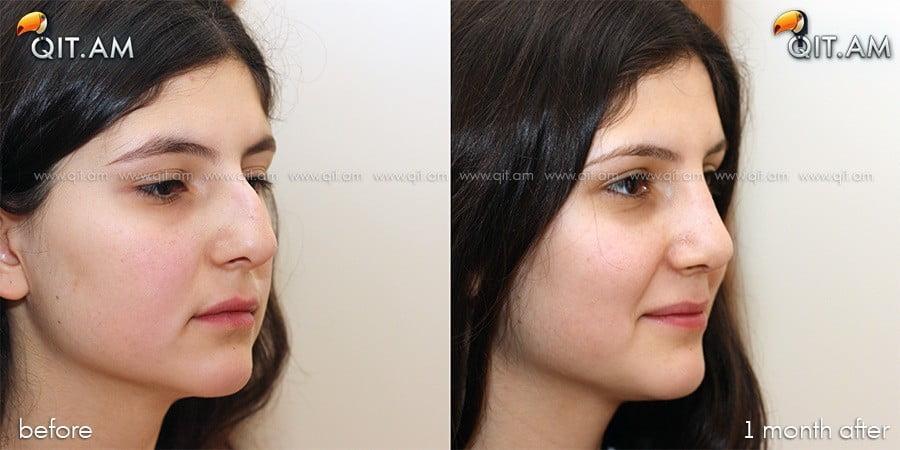
A young woman approached me with an aesthetic request to remove a large, rigid hump. This anatomical feature projected significantly forward in profile, depriving the face of its natural softness. Furthermore, a detailed medical history revealed that the patient regularly experienced difficulty with nasal breathing, especially when lying down, which indicated concomitant internal issues.
Initial anatomical features (“Before” photos)
During the examination of the face in profile and three-quarters view, I noted the following anatomical markers requiring surgical correction:
- Nasal dorsum: a prominent, high osteocartilaginous hump was identified, creating a sharp, broken profile line and visually weighing down the middle third of the face.
- Nasal tip: had an excessive projection (length) and was directed downwards. The acute nasolabial angle visually aged the young patient, making the facial expression look overly strict and tired.
- Skin: moderately thick, with good contraction potential. When working with this type of skin, it is crucial to create a stable, well-defined cartilaginous support so that the new contours do not become “blurred” during the healing process.
Surgical procedure and objectives
My main goal was to make the nose neat, feminine, and well-proportioned, while completely preserving the individuality and natural appearance of the patient’s facial features.
As the first, functional step, I performed a septoplasty — carefully correcting the deviated parts of the internal nasal septum to completely open the airways. Next, I proceeded with open rhinoplasty: performed a careful reduction (lowering) of the osteocartilaginous section of the nasal dorsum and executed a delicate osteotomy to narrow it. I paid special attention to the lower third: shortened the nasal tip projection, altered its rotation (gently lifting it upwards), and securely fixed the cartilaginous structures at an aesthetically ideal, open nasolabial angle.
Early result after 1 month (“After” photos)
The “After” photos present an early result — only 1 month has passed since the operation. At this stage, primary postoperative swelling still persists in the tissues (especially in the nasal bridge and the tip itself), which will gradually and unevenly resolve over the course of a year.
Nevertheless, the difference between “Before” and “After” is already obvious and beautiful:
- Smooth lines: instead of a sharp hump, a straight, graceful nasal dorsum has appeared, with a natural transition to the glabella area.
- Neat tip: the nose has become noticeably more compact, the tip is lifted, and the former visual heaviness is gone.
- Rejuvenating effect: the patient’s face instantly refreshed, the look became more open, and the overall image became soft, gentle, and harmonious.
Despite the fact that the nose has yet to undergo the process of final shaping and tissue shrinkage, the patient is already incredibly happy. She breathes freely through her nose and is delighted to note that she has got rid of long-standing insecurities.
&description=&image=https://new.nose.am/wp-content/uploads/2026/07/105_case_1_preview.jpg)