
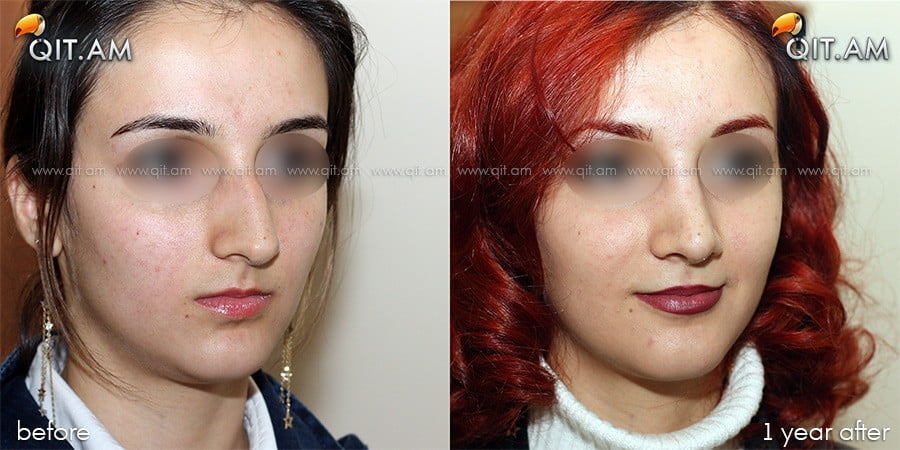
Wishing to change the shape of her nose and make her facial features softer and more feminine, a young patient visited my clinic. The main source of her dissatisfaction was a large hump, which made her profile look excessively harsh and stern. In addition, as is often the case with pronounced deformations of the external nose, the patient complained of periodic difficulty in nasal breathing.
Initial anatomical features (“Before” photo)
Upon examination from a three-quarters view, I identified key structural issues that required surgical correction:
- Pronounced osteocartilaginous hump. It protruded significantly forward, visually breaking the line of the nasal bridge and drawing all the attention to itself.
- Elongated and slightly drooping nasal tip. In combination with the hump, such a tip visually weighed down the middle third of the face, made the nasolabial angle too acute, and gave the face an excessively stern, frowning appearance.
- Deviated septum. Internal examination confirmed the presence of a deformation that significantly blocked the airflow and interfered with full breathing.
- Medium density skin. This is a good ally for the surgeon: it is elastic enough to contract properly after reducing the nasal volume, and at the same time, it is capable of gently smoothing out the defined edges of the new cartilaginous framework.
Course of the operation and the surgeon’s tasks
My main goal was to remove the dominant hump and create a graceful, neat silhouette that would emphasize the natural beauty of the patient’s large eyes and beautifully shaped lips.
I performed a closed rhinoseptoplasty. The first stage was septoplasty: I gently straightened the septum, restoring the correct internal aerodynamics of the nose and opening the way for free breathing.
Then I proceeded to aesthetic modeling. I carefully resected the excess bone and cartilage tissue on the bridge of the nose, smoothing it out and making it neat along its entire length. After that, I worked on the tip cartilages: I reduced the overall length of the nose, slightly lifted the tip (performed a delicate upward rotation), and securely fixed it in the new position. This allowed opening up the nasolabial angle, making the facial expression look more open and friendly.
Stable result after 1 year (“After” photo)
In the “After” photos, we see the patient exactly one year after the surgery. By this time, the tissues have fully recovered, even the deepest post-operative swelling has subsided, and we can evaluate the final, stable result:
- The bridge line has become flawlessly straight, smooth, and natural.
- The tip of the nose has acquired a neat shape; it is stable, has not drooped under the influence of facial expressions, and perfectly harmonizes with the new facial proportions.
- The perception of her appearance has completely changed: the patient’s face looks incredibly soft, feminine, and fresh. The girl’s new, radiant look only emphasized the self-confidence she gained after the transformation.
Nasal breathing has been fully restored—the patient has forgotten about drops and congestion forever. She is absolutely happy with the result achieved, and for me, the best reward is to see how precise correction helps to fully reveal the harmony of the face.
&description=&image=https://new.nose.am/wp-content/uploads/2026/07/104_case_1_preview.jpg)