
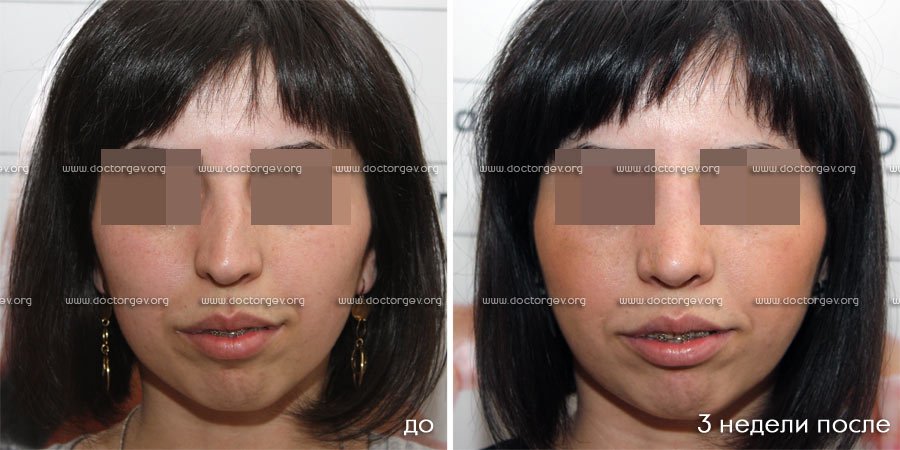
A young female patient undergoing orthodontic treatment approached me with a request to correct a pronounced nasal asymmetry. A logical step towards ideal facial harmony was the elimination of post-traumatic or congenital nasal curvature. In addition to the obvious aesthetic imperfection, the patient complained of constant congestion in one side of the nose, severe fatigue, and the inability to breathe fully.
Initial Anatomical Condition (Before Surgery):
- Frontal view: A severe S-shaped curvature of the nasal pyramid was clearly visualized. The nasal bridge was displaced relative to the central facial axis, creating asymmetric light reflections and visually distorting the proportions.
- Nasal tip: Due to the deformation of the supporting cartilaginous structures, the nasal tip was also shifted to the side, appearing asymmetrical and slightly ill-defined.
- Functional state: During the internal examination, I diagnosed a severe degree of nasal septum deviation. The internal airways were almost completely blocked on one side, making full nasal breathing impossible.
Surgical Procedure and Objectives:
In this case, I faced a highly challenging task — not just to make the nose beautiful, but literally to rebuild it from scratch along the central facial axis, while ensuring flawless functionality. Every movement had to be precise to the millimeter to balance the naturally asymmetric cartilages.
I performed a comprehensive rhinoseptoplasty. The first and most crucial stage was septoplasty: I completely reconstructed the deviated cartilaginous and bony parts of the septum, returning it to a strictly vertical position. Next, using precision osteotomy, I mobilized and aligned the bones of the nasal bridge, assembling them along an ideal midline. The final stage was the symmetrical remodeling and centering of the nasal tip, reinforcing its cartilaginous framework with autografts.
Result (3 weeks after surgery):
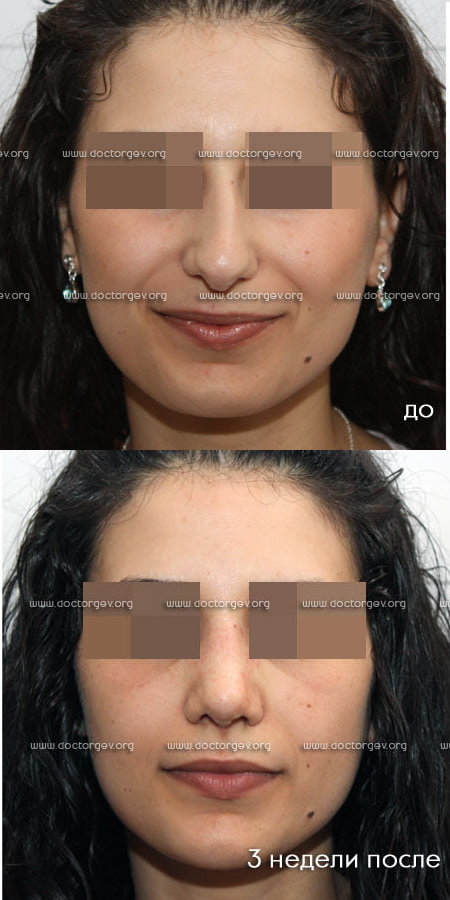
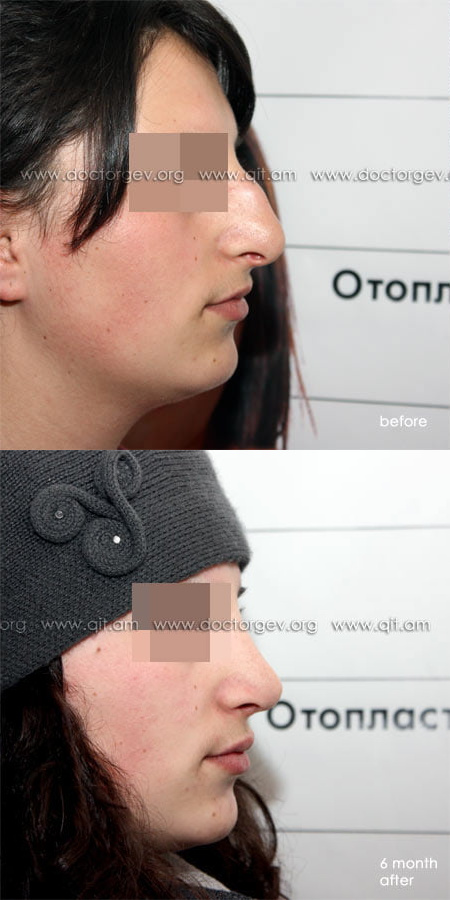
In the photographs, we see the result of the early postoperative period — just 3 weeks after the intervention. At this stage, residual swelling still persists on the face (especially in the supratip area and the nasal wings), which will gradually subside over several months.
However, key changes are already visible now:
- Ideal axis: The nose has become absolutely straight, centered, and symmetrical. The “crookedness” effect has disappeared, and the light reflex now falls in a smooth, elegant line.
- Harmonization of features: The patient’s face was instantly transformed, looking more balanced, refined, and soft. The new neat nose beautifully highlighted her eyes and corrected the overall proportions.
- Free breathing: The septum is aligned, and airflow is fully restored.
My patient already notes that her life has been divided into “before” and “after”: she is delighted with her new reflection in the mirror and has finally forgotten about drops and nasal congestion, enjoying free breathing.
&description=&image=https://new.nose.am/wp-content/uploads/2026/07/073_case_1_preview.jpg)