
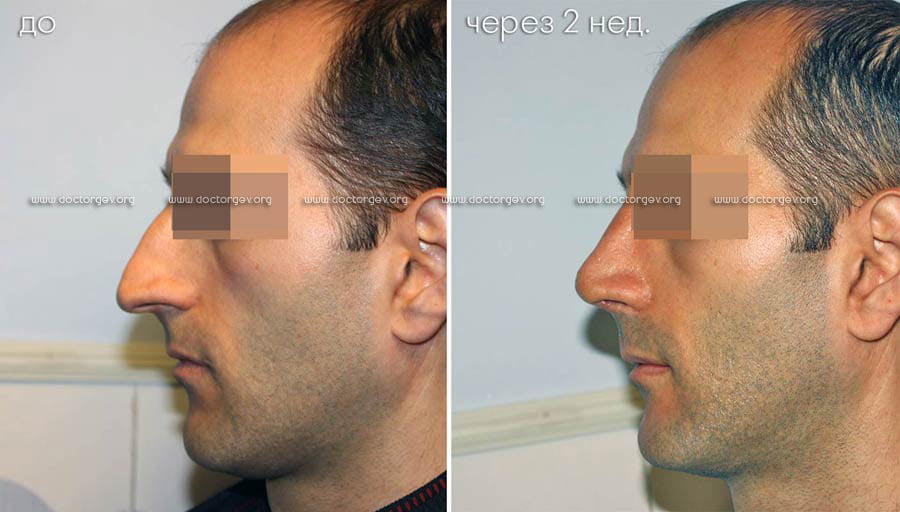
A young man approached me with a request classic for male patients. He was deeply dissatisfied with a large, sharply prominent hump on the nasal bridge and a droopy tip that made his profile look visually heavy and harsh. In addition to pronounced aesthetic discomfort, the patient complained of chronic difficulty in nasal breathing, which worsened during sleep and physical activities — a consequence of a severe deviation of the internal cartilaginous septum.
Initial Anatomical Findings (Before Surgery):
- Profile: A pronounced excess of osteocartilaginous structures was visualized. A high, sharp dorsal hump dominated the face. The nasal tip was severely drooped downwards (hooked nose deformity), forming an extremely acute nasolabial angle, which visually aged the young man.
- Skin Quality: The patient has classic male skin — dense, thick, with well-developed sebaceous glands. Working with this type of skin requires the rhinosurgeon to create a strong, stable, and well-defined cartilaginous framework, otherwise, the new contours may lose their definition under the dense tissues.
Surgical Goals and Characteristics of Male Rhinoplasty:
Male rhinoplasty fundamentally differs from female rhinoplasty. Here, it is critically important to avoid feminization of the face: there should be no excessive dorsal scooping (“snub nose” effect) or an overly upturned nasal tip. My goal was to create a strong, straight, masculine profile while simultaneously reducing the overall volume of the nose.
During the surgery, I performed a closed rhinoseptoplasty. First, I carried out a delicate reduction of the osteocartilaginous hump and performed an osteotomy to narrow the nasal bridge. Then, I meticulously reshaped the tip: repositioned the alar cartilages, slightly reduced their length, and performed an upward rotation, fixing the tip in a physiologically correct position. An essential step was a deep septoplasty with alignment of the nasal septum and correction of the inferior turbinates to restore breathing.
Result (2 weeks post-operation):
The photographs show a very early result — just 14 days after the surgical intervention (on the day of splint and suture removal). Despite the fact that dense post-operative swelling still persists at this stage (especially in the nasal bridge and supratip areas), the transformation dynamics are obvious:
- The massive hump has been completely eliminated, and the nasal bridge is now smooth and refined.
- The nasal tip was shortened, lifted, and secured. The nasolabial angle now corresponds to ideal male parameters (about 90–95 degrees).
- The profile has become balanced, harmonious, and proportional, while completely preserving the masculinity and individuality of the facial features.
- The main functional outcome is that the internal airways are completely clear, and the patient can finally breathe freely.
As the thick skin contracts over the coming months, the swelling will subside, the nose will become even more refined, and the result will look completely natural. The patient is incredibly pleased with the initial changes and the quality of his new breathing.