
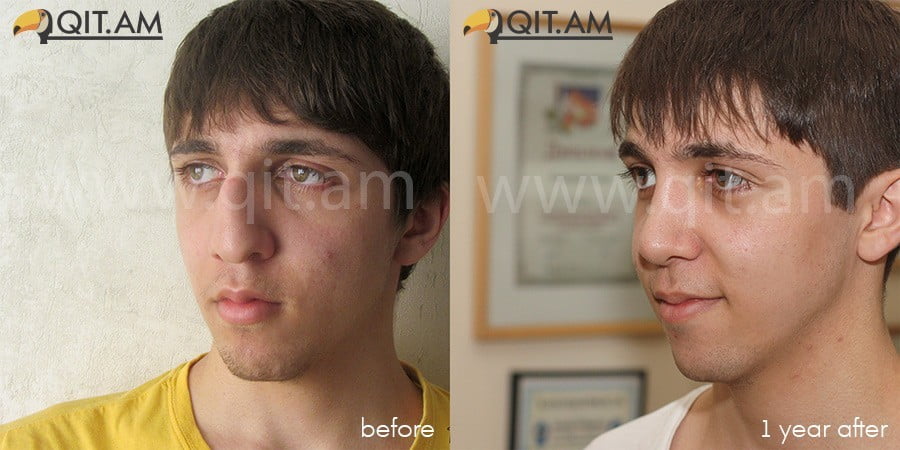
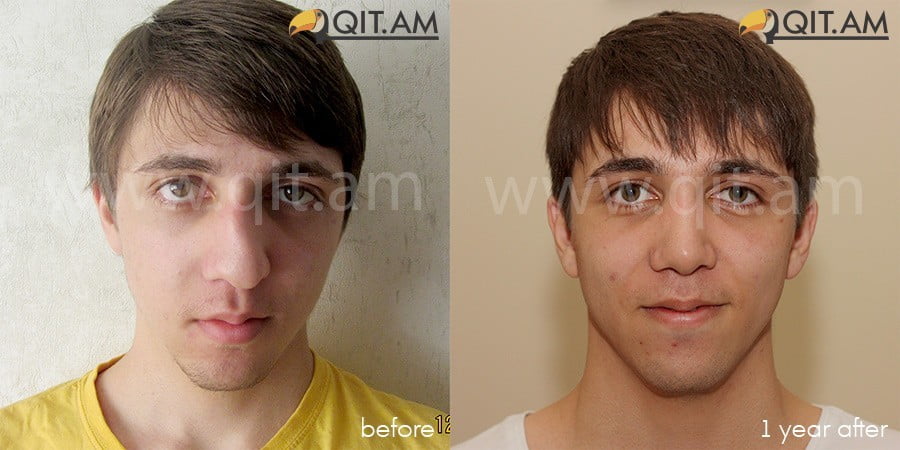
A young man presented with pronounced aesthetic and functional consequences of trauma. In this case, we were dealing with a complex deformity which, judging by the tissue architectonics, resulted from a prior blow. The patient complained of persistent nasal congestion, inability to breathe properly, and severe visual crookedness.
Anatomical Analysis “Before” Surgery
During the examination, I noted critical violations in the geometry of the external nose and internal structures:
- Nasal axis deviation: There was a pronounced S-shaped deviation of the entire nasal pyramid. The dorsum was severely shifted to the side, the bony vaults had different lengths and shapes, and a prominent asymmetrical hump was present.
- Nasal tip: It was deformed, flattened, and shifted along with the general nasal axis, losing its definition of contours.
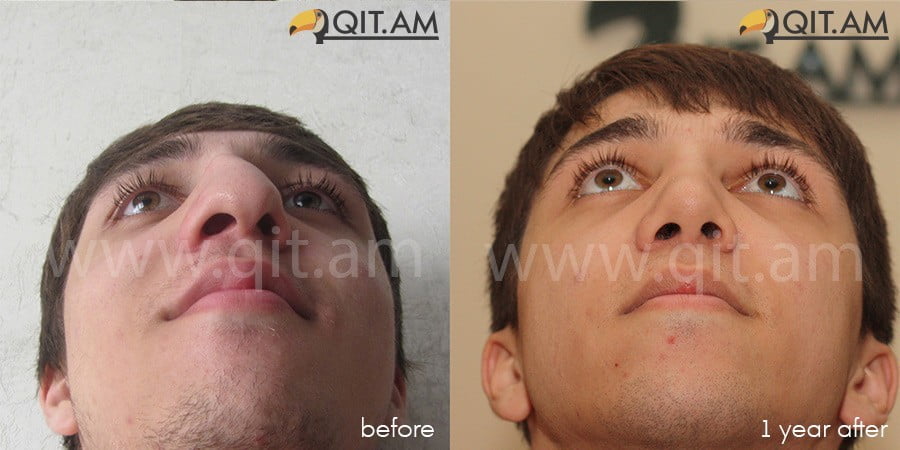
- Bottom view (basal view): This image most clearly reflects the scale of the problem. The caudal (anterior) margin of the septal cartilage was completely dislocated and shifted to the side, almost completely blocking the right nasal passage. Because of this, the nostrils had completely different shapes, and nasal breathing on the right side was virtually absent.
- Thick skin: The patient has fairly thick skin, which always requires jewelry-like precision from the surgeon when working with the underlying framework — the structures must be shaped so that the result is discernible even through a thick skin flap.
Surgical Course and Objectives
Performing male rhinoplasty always requires the utmost precision from the surgeon: hypercorrection must be strictly avoided here. My task was to restore the anatomical norm, make the nose straight and symmetrical, while preserving masculine, strong facial proportions — without excessive narrowing of the dorsum or rotation of the tip.
First of all, I performed an extensive septoplasty: I isolated, straightened, and securely fixed the nasal septum in the midline, completely clearing the airways. Then, using precise osteotomy, I mobilized the deviated nasal bones and returned them to a central position, simultaneously removing the hump and straightening the dorsum. Finally, meticulous work was performed on the nasal tip cartilages — I restored their symmetry, centered the tip, and aligned the shape of the nostrils.
Result 1 Year After Surgery
A year after the intervention, when all residual swelling has completely subsided, we can evaluate the final result:
- Impeccable geometry: The nose became completely straight, the axis is centered, and the asymmetry of the bony and cartilaginous structures is fully eliminated. The dorsum has smooth, well-defined masculine lines.
- Restoration of architectonics: The frontal and three-quarter views show how harmoniously the new nose blends into the overall facial features, making the appearance more strong-willed and balanced. The nasal tip is well-defined, neat, and symmetrical.
- Full functional recovery: The basal view (from below) clearly shows that the septum now occupies a strictly midline position. The nasal passages are completely clear, and the shape of the nostrils is symmetrical.
The patient not only received a beautiful, natural masculine nose but also got rid of a long-standing breathing problem. The result is stable, and the young man’s quality of life has reached a fundamentally new level.