
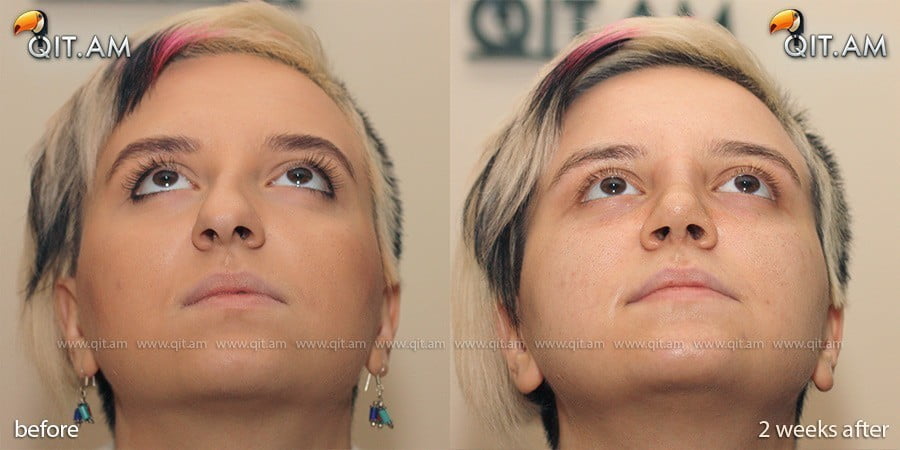
A vibrant young patient came to my consultation seeking aesthetic and functional correction of her nose. The main aesthetic complaints were a pronounced hump, which deprived the profile of its grace, and a rather wide, “heavy” nasal tip. Furthermore, during the examination, I revealed a deviated nasal septum, which, in addition to causing asymmetry in the frontal projection, led to chronic problems with full nasal breathing for the young woman.
Initial Anatomical Features (Before Surgery):
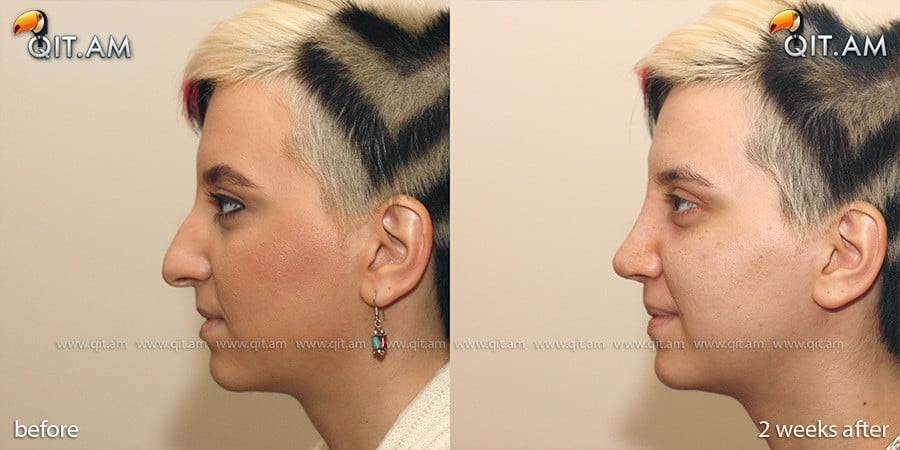
- Profile: A large osteocartilaginous hump was clearly visualized, disrupting the smoothness of lines and adding excessive sharpness to the facial features. The nasal tip was droopy, which visually elongated the middle third of the face.
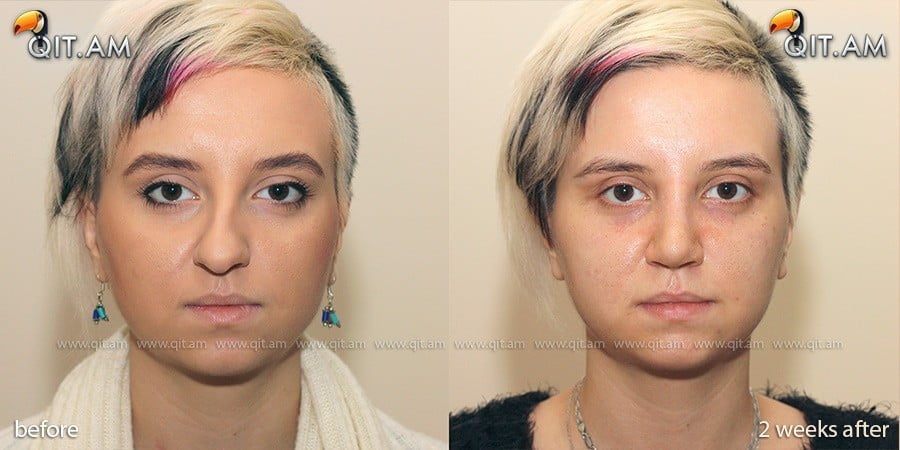
- Full face and basal projection: The nasal axis was slightly deformed. The nasal tip appeared voluminous and poorly defined due to the wide positioning of the lateral crura of the alar cartilages.
- Skin quality: The patient’s skin is rather thick, which is always a challenge for a rhinoplasty surgeon. Thick skin tends to retain postoperative swelling longer and requires meticulous, precise work with the underlying cartilaginous framework so that the new contours can beautifully emerge through the tissues.
Surgical Course and Objectives:
My primary goal was to create a neat, natural-looking nose that would perfectly complement the patient’s unique and extraordinary appearance while preserving her individuality.
During the operation, I performed a careful osteotomy and delicately modeled the nasal bridge, completely eliminating the hump and shaping a smooth, noble profile line. I paid special attention to working with the tip: excess cartilaginous tissue was excised, and the alar cartilages themselves were brought closer together and securely fixed. I slightly lifted the tip to relieve the face of visual heaviness. Also, a septoplasty was performed to straighten the septum and fully restore free breathing.
Result (2 weeks after surgery):
In the presented photographs, we can see an intermediate result just 14 days after the intervention. Despite the fact that for thick skin at this stage a moderate swelling is still characteristic (especially in the area of the tip and the nasal bridge), the changes are colossal:
- The hump has disappeared, and the profile has become soft and harmonious.
- The nasal tip has acquired a clear structure, becoming more elegant, refined, and slightly lifted, opening up the nasolabial angle.
- Symmetry of the nostrils and the nasal bridge in the front view has been restored.
- The face has begun to look more open, gentle, and fresh.
Already at this early stage, the patient is incredibly satisfied with the first results and, most importantly, notes that her nose is finally breathing at full capacity. Within six months, the swelling will completely subside, and the contours will become even more defined and neat.