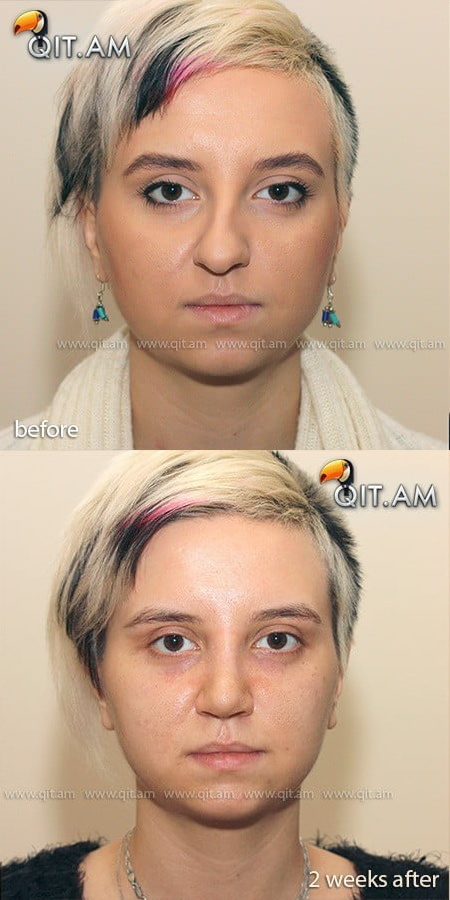

A young female patient came to me for an initial consultation with a request for facial harmonization. Her main aesthetic concerns were a large dorsal hump and visual heaviness of the nose, which disrupted the proportionality of her features.
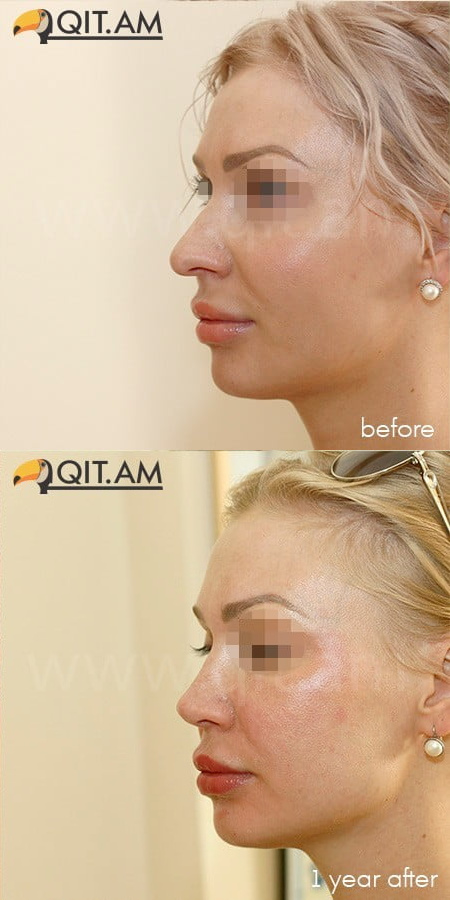
During the initial examination, I noted a pronounced osteocartilaginous hump on the nasal dorsum. The nasal tip was droopy and lacked stable support, which visually elongated the middle third of the face and gave the look an excessively stern and tired appearance. The patient’s skin is quite thin and elastic — this is an ideal material for demonstrating the surgeon’s precision work, but at the same time, it carries an immense responsibility, as even the slightest imperfection in modeling the framework is visible on such skin.
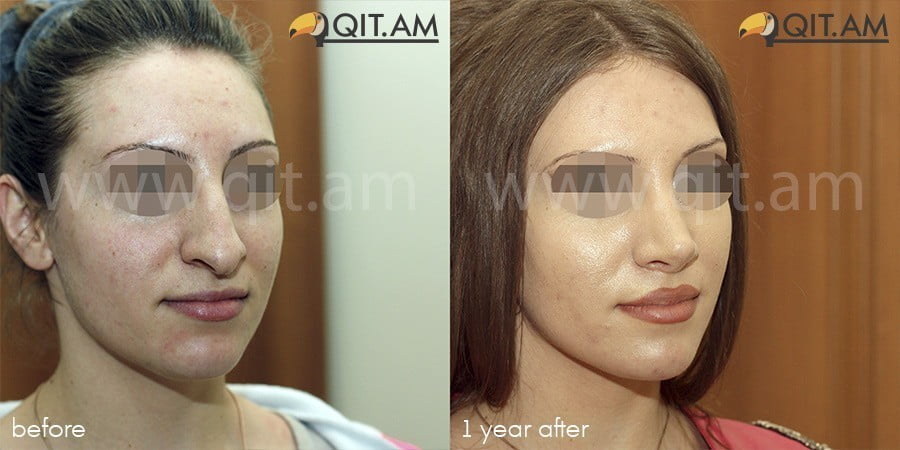
My primary goal was to remove the hump and create an absolutely smooth, natural dorsal line without the “operated” nose appearance. During the surgery, I performed a careful resection of the osteocartilaginous component, narrowed the nasal bridge, and executed a delicate tip rhinoplasty: elevated it, adjusted the rotation, and securely fixed it in a new, more elegant position. In parallel, the internal septum was corrected to improve respiratory function.
The photo shows the result 1 year after the surgery. During this period, all residual swelling has completely subsided, and we can evaluate the final contour. The nose became neat, sculpted, and harmonious. Changing the direction of the nasal tip opened up the nasolabial angle, which instantly transformed the patient’s face — it began to look significantly softer, fresher, and younger. The new aesthetic appearance completely preserved the young woman’s individuality, restoring her self-confidence and free nasal breathing.