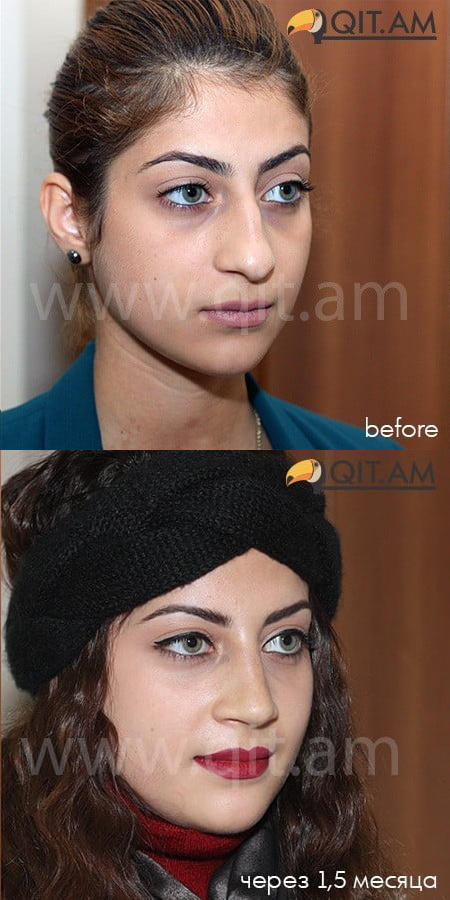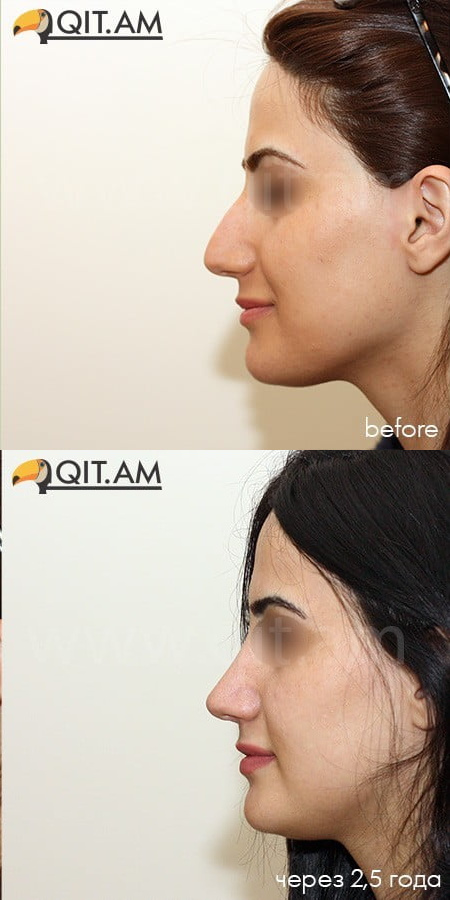

A young woman approached me with a classic request for aesthetic correction. Her primary complaint was related to the shape of her nose: a pronounced hump, in the patient’s opinion, made her face look overly stern and harsh, depriving her profile of the desired femininity and softness.
Initial anatomical presentation (Before)
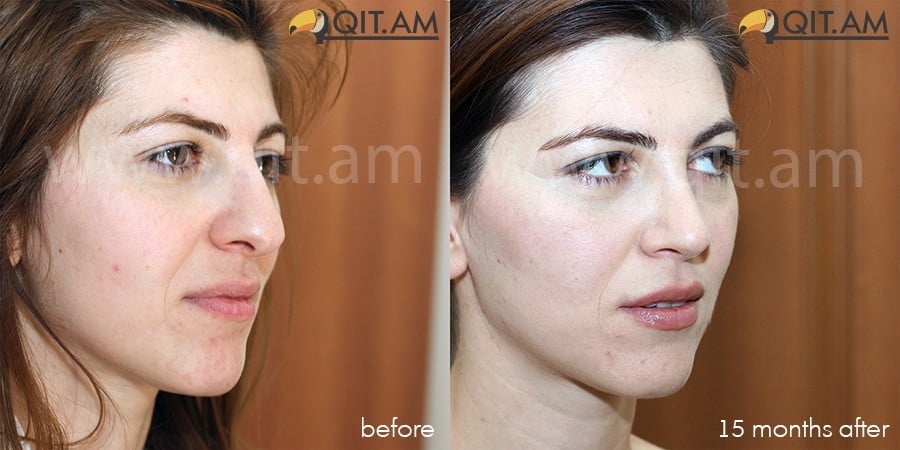
When analyzing the face from a three-quarter view (semi-profile), I identified the following key features:
- High osteocartilaginous hump: The nasal bridge had a sharp, protruding contour that visually drew all the attention and disrupted the overall proportions of the face.
- Apparent lengthening and drooping of the tip: Due to the high projection of the bridge, the nasal tip visually appeared to point downwards, adding heaviness to the middle third of the face.
- Thin skin: The patient has fairly thin and elastic skin. For a surgeon, this is always an area of increased responsibility. The advantage of thin skin is that it drapes perfectly and highlights the new, elegant framework. The downside is that, like a thin veil, it reveals any imperfections, so the work on the bones and cartilage must be unprecedentedly precise, literally meticulous.
Surgical goals and the course of correction
My primary goal was to create an absolutely natural, “unoperated” nose that would perfectly blend into the patient’s facial structure without compromising her individuality.
I performed a gentle reduction of the bony and cartilaginous components of the nasal bridge, completely eliminating the hump and shaping a smooth, elegant profile line. To avoid a “long nose” appearance, I worked on the tip area: performed a careful rotation (slightly elevating the tip) and modeled its new, more refined and neat contours. Additionally, considering complaints of occasional breathing difficulties during sleep, I performed internal functional correction, restoring proper aerodynamics of the nasal passages.
Result 15 months after surgery (After)
In the photo on the right, we can see a long-term, stable result after 15 months. By this time, residual swelling has completely resolved, and the tissues have finally settled into their new position.
The results of our joint work:
- The bridge line has become flawlessly smooth, graceful, and feminine.
- The nasal tip has been elevated, the previous heaviness is gone, and the projection has become harmonious.
- Natural appearance is completely preserved — the nose looks as if the patient was born with it.
Correcting just one dominant defect completely transformed the overall perception of the face. The features became softer, natural gentleness emerged, and the patient’s gaze appeared more open. The patient is happy, has freed herself from long-standing insecurities, and feels completely confident.