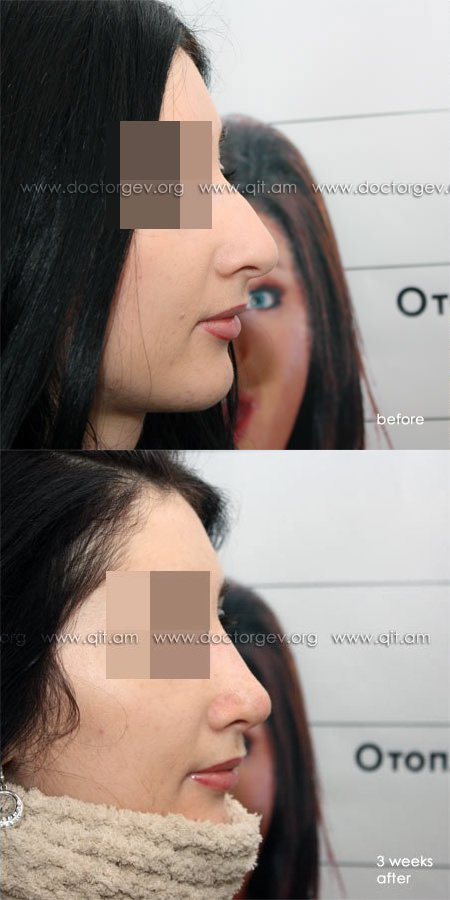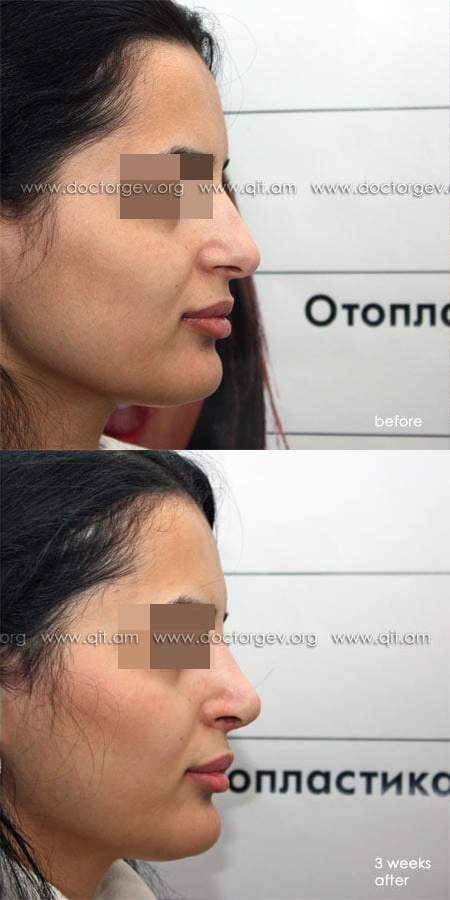

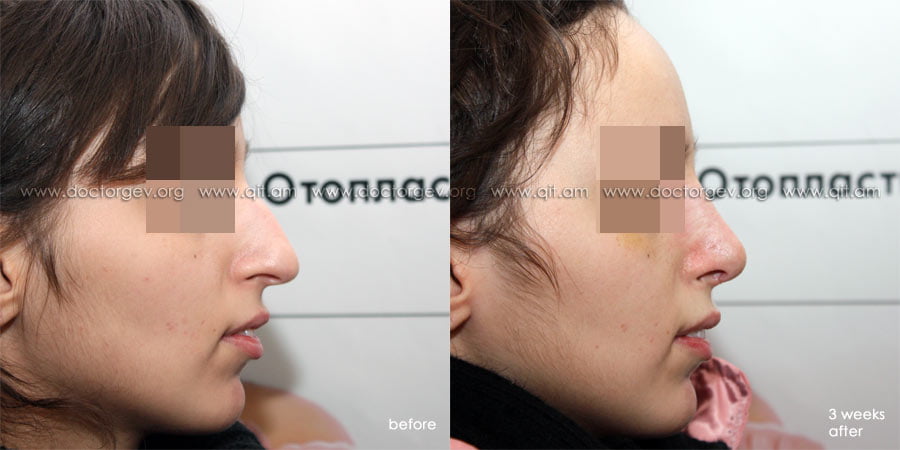
A young woman consulted with me with a clear request to reshape her profile. The main source of her aesthetic discomfort was a large, rigid hump, which gave her face an excessively harsh and masculine appearance, completely overshadowing the natural softness of her other facial features.
Initial Anatomical Picture (Before Surgery)
Analyzing the patient’s profile photographs, I identified the following anatomical features that determined the surgical plan:
- Nasal bridge: There was a high, sharply defined osteocartilaginous hump with a steep incline toward the tip. This shape visually weighed down the upper and middle thirds of the face.
- Nasal tip: It was excessively long, projected forward, and slightly drooping. The nasolabial angle was overly acute, visually making the nose look even more massive and the face look more tired.
- Anatomical background: Given the scale of the bony deformation on the bridge, I also anticipated a concomitant nasal septum deviation, which was confirmed during the examination—the patient complained of periodic nasal congestion.
Surgical Procedure and Objectives
My primary goal was to perform a structural rhinoseptoplasty: to completely eliminate the hump, harmonize proportions, and create a soft, feminine profile while preserving stable nasal breathing.
During the surgery, I performed:
- Functional restoration: Straightened the nasal septum, establishing a correct and symmetrical internal framework.
- Bridge correction: Carefully resected the osteocartilaginous excess, smoothing the profile line, and performed an osteotomy to reconstruct a slender, refined nasal bridge in frontal view.
- Tip reshaping: Shortened the tip, elevated it (performed cartilage derotation), and secured it in the new position. This opened up the nasolabial angle and gave the nose a neat, subtly upturned, yet completely natural appearance.
Results 3 Weeks Post-Op
The “After” photo captures a very early stage of rehabilitation—only three weeks have passed since the surgery. A typical clinical picture is characteristic for this timeframe:
- Residual signs on the skin remain in the form of slight yellowish bruising (resolving hematomas) around the bridge of the nose and cheek.
- The nasal tissues, particularly around the tip and supratip area, exhibit marked postoperative swelling, which will gradually subside over the coming months.
Despite being an intermediate healing stage, the aesthetic success is already obvious. The profile has changed dramatically: the harsh hump has yielded to an ideally smooth, fluid line. The nose is shorter and neater, the tip is elevated, and the entire face instantly looks younger, softer, and more attractive. The patient breathes freely and is already thrilled with her new look. The full elegance of the contours will unfold closer to six months as the tissues recover completely.