
An adult man approached me for a consultation. Often, patients at this age come not only for aesthetic transformation but also with accumulated functional complaints that significantly reduce their quality of life.
Initial anatomical features
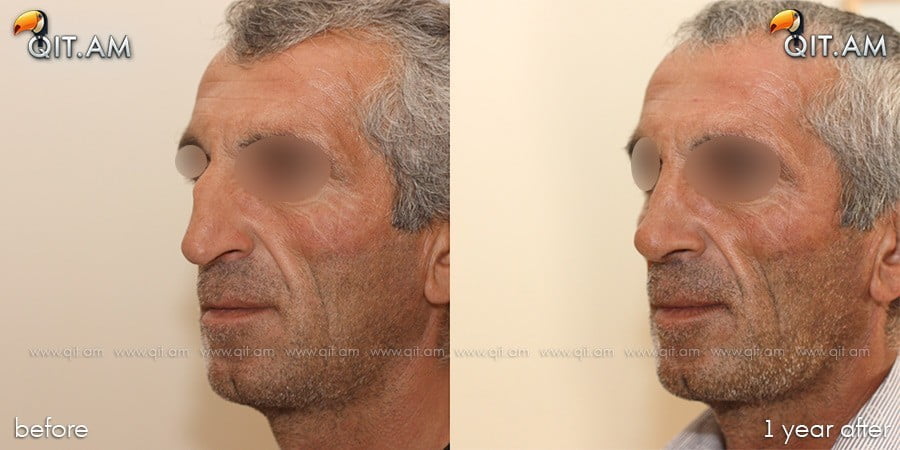
Upon detailed examination, I noticed a massive nasal dorsum with a pronounced hump and a severely drooped, heavy tip. Such anatomy visually elongated the face, giving it a tired and older appearance.
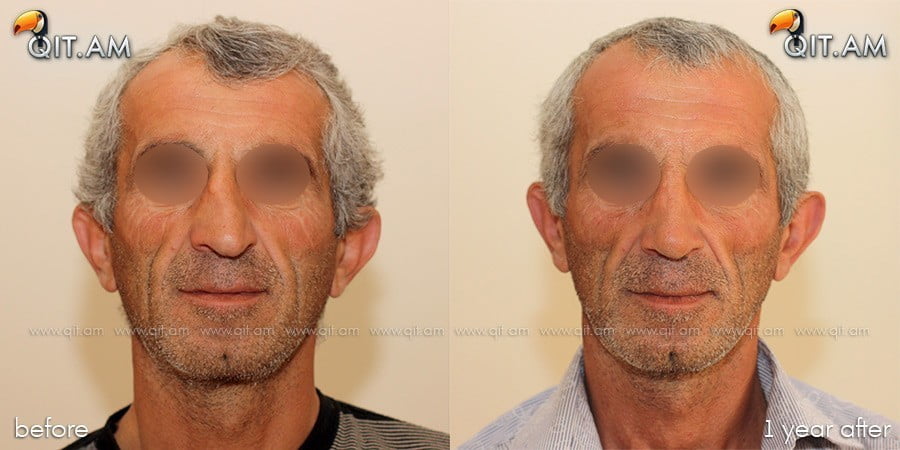
In addition, when evaluating the full face view, an asymmetry of the nasal axis was noticeable, clearly indicating a deviated septum and, as a result, difficulties with nasal breathing.
I would like to separately note the quality of the tissues: the patient has rather thick, porous, and heavy male skin. For me, this always means a more complex surgical task—creating a neat and defined tip under such a skin flap requires precise work with the cartilaginous framework and the formation of a very reliable internal support.
Surgical Course and Objectives
I performed a comprehensive functional and aesthetic rhinoseptoplasty. My main goal was to restore full, free breathing and harmonize the facial features, while strictly preserving its masculinity.
I carefully lowered the nasal dorsum, gently removed the hump, straightened the septum, and lifted the tip, giving it the correct anatomical projection.
Result 1 Year Later
Now, evaluating the result exactly one year after the surgery, I can confidently say that we have achieved perfection. The tissues have completely “settled,” and all deep swelling has subsided.
The nose has become straight, proportional, and neat, yet it looks completely natural—without the slightest hint of surgical intervention. The patient’s face has noticeably transformed: his gaze has become more open, the former heaviness is gone, and visually, the man looks several years younger. My patient is genuinely pleased with the result: he found harmony in the mirror and, most importantly, can finally breathe deeply.
&description=&image=https://new.nose.am/wp-content/uploads/2026/07/116_case_1_preview.jpg)