
Initial clinical picture
Wishing to change the dominant shape of her nose and restore harmony to her face, a young woman turned to me. The nose was the dominant facial feature, drawing all the attention to itself.
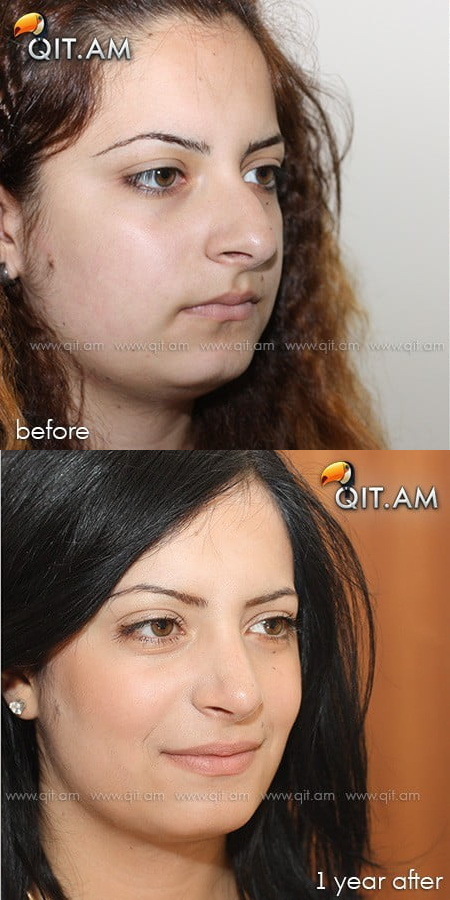
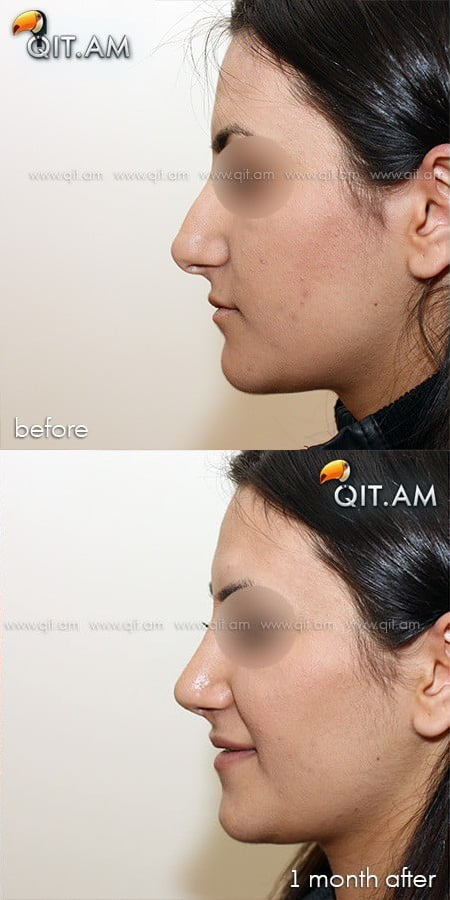
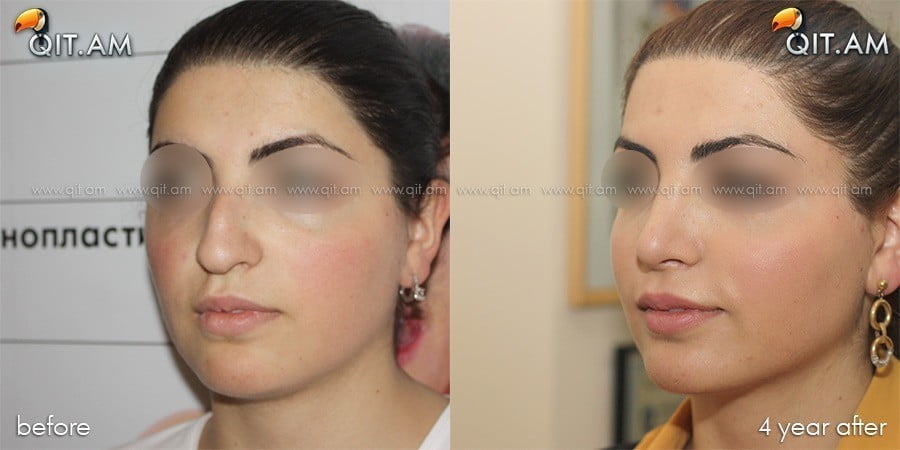
When analyzing the initial anatomical features “Before” (in the three-quarter view), I highlighted the following key points:
- Nasal dorsum: a large, high osteocartilaginous hump was identified, which disrupted the smoothness of the profile lines and made it look visually harsh.
- Nasal tip: looked massive, under-projected, and slightly droopy. Because of this, the nose appeared excessively long, which visually aged the patient and gave the face a tired look.
- Skin quality: the patient has quite thick, porous skin. In rhinoplasty, working with such skin requires special skill from the surgeon: thick tissues are reluctant to contract and can conceal the elegant changes in the underlying cartilages. Therefore, it was necessary to form a very distinct and stable cartilaginous framework here.
- Functional state: as expected with such an external deformity, the patient had a pronounced deviation of the nasal septum, leading to chronic impairment of nasal breathing.
Operation progress and surgical tasks
My main goal was to perform a simultaneous (combined) rhinoseptoplasty. The task was to completely restore free breathing and perform facial beautification — making the nose neat, proportionate, and natural.
During the surgery, I performed a septoplasty, eliminating the septal deviation and normalizing airflow. Then I moved on to the aesthetic stage: I carefully resected the hump and precisely rasped the nasal dorsum to achieve a perfectly smooth contour. I paid special attention to working with the tip section: I changed the rotation of the nasal tip, gently lifting it, and narrowed the alar cartilages. Using osteotomy, the nose was narrowed in the middle and upper thirds so that it would look elegant not only in profile but also en face.
Result after 4 years
The presented case is unique in that in the “After” photos, we see a stable long-term result 4 years after the surgery. This is the exact time when all the processes of scarring and thick skin contraction have long been completed, and we can evaluate the true reliability of the performed reconstruction.
The new nose has flawlessly passed the test of time. The nasal dorsum has remained absolutely straight, without deformations or contouring. The nasal tip has retained its elegant projection, clear outlines, and no longer drops. The facial proportions have become fully balanced: the gaze has become more open, and the entire look is surprisingly soft, delicate, and harmonious. The patient breathes absolutely freely and, throughout all four years, looks in the mirror with joy every day, feeling confident and beautiful.