
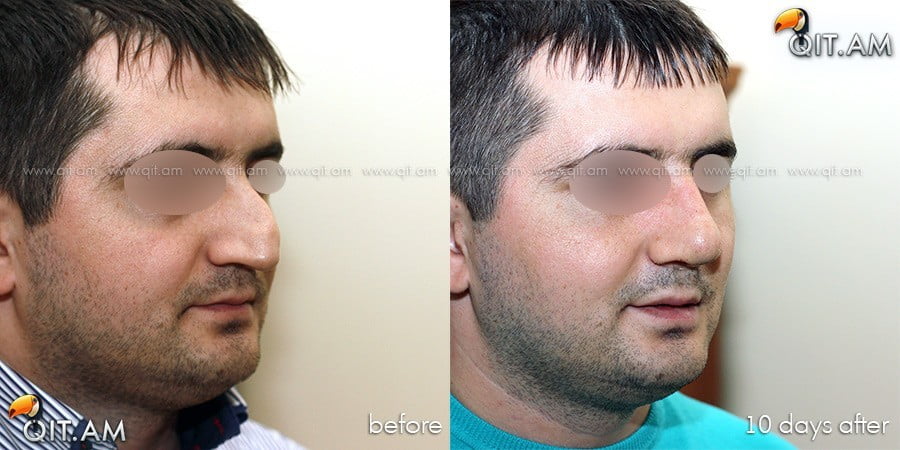
A young man approached me with requests classic for male rhinoplasty. He was dissatisfied with a large, prominent dorsal hump and a noticeably droopy nasal tip, which weighed down his facial expression and made his profile appear overly severe. As is often the case with such significant anatomical changes to the structural framework, the patient also complained of impaired nasal breathing, especially during physical exertion and sleep.
My main goal as a plastic surgeon was to restore the proper internal architecture of the nose for unobstructed breathing while performing a delicate aesthetic correction. In male rhinoplasty, maintaining balance is paramount: correcting defects while preserving the masculine, strong character of the face, strictly avoiding an over-scooped dorsum or an excessively upturned tip.
Preoperative Anatomical Analysis:
- Nasal bridge: A massive, high osteocartilaginous hump was identified, disrupting overall facial proportions.
- Nasal tip: Heavy, drooping downward (tip ptosis), with a distinct lack of cartilaginous support.
- Skin quality: Thick, typically male skin. Working with such skin requires meticulous structuring of the cartilaginous framework so that the new, more refined contours of the bridge and tip clearly show through its thickness.
- Function: Nasal septum deviation in the cartilaginous section significantly obstructed one of the nasal passages.
Surgical Goals and Procedure:
I performed a simultaneous rhinoseptoplasty. First, I carried out a septoplasty, correcting the septal deformity and opening up the airways. Then, I proceeded to model the shape of the nose: carefully resected the hump, smoothed the bony vault, and performed an osteotomy to narrow the nasal bridge, making it perfectly straight.
The nasal tip was delicately raised to an anatomically correct position, forming a straight, masculine nasolabial angle. I reinforced the tip area with cartilage grafts to secure the shape and prevent future drooping.
“After” Result (Only 10 Days Post-Op):
The photos showcase an ultra-early result — only 10 days have passed since the operation, and we have just removed the splint. During this period, maximum postoperative swelling is present on the face, particularly around the nasal tip and bridge, which will gradually subside over the course of a year.
Nevertheless, the “before” and “after” difference is already impressive:
- The massive dorsal hump has been completely eliminated — the nasal bridge is now straight and refined.
- The nasal tip no longer droops, giving the profile a balanced and harmonious look.
- The nose is now proportionate to the rest of the facial features, creating a more open and attractive look without losing individuality.
- The patient immediately noticed a dramatic improvement in nasal breathing.
Even though a long rehabilitation process and final tissue settling lie ahead, my patient is already genuinely happy to see such positive changes in the mirror at this stage.
&description=&image=https://new.nose.am/wp-content/uploads/2026/07/096_case_1_preview.jpg)