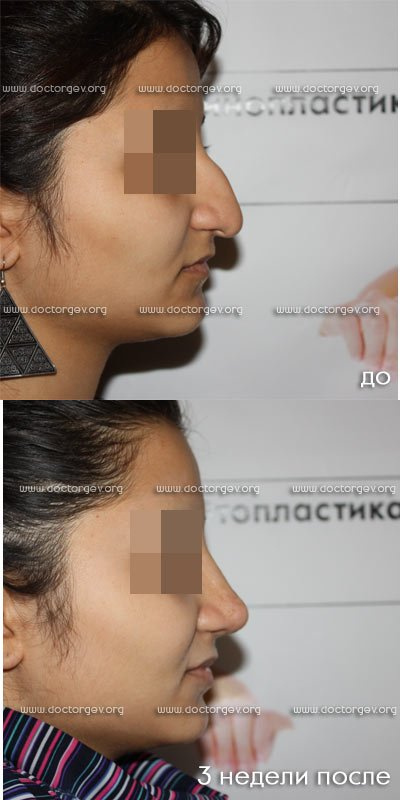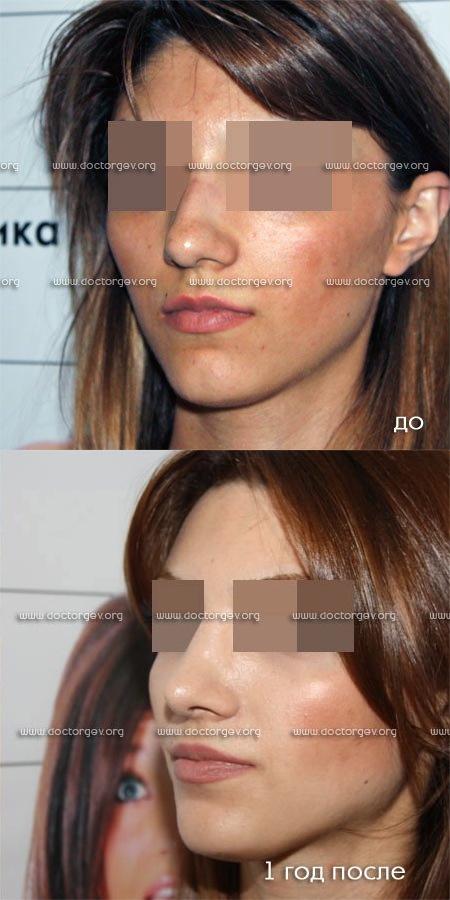

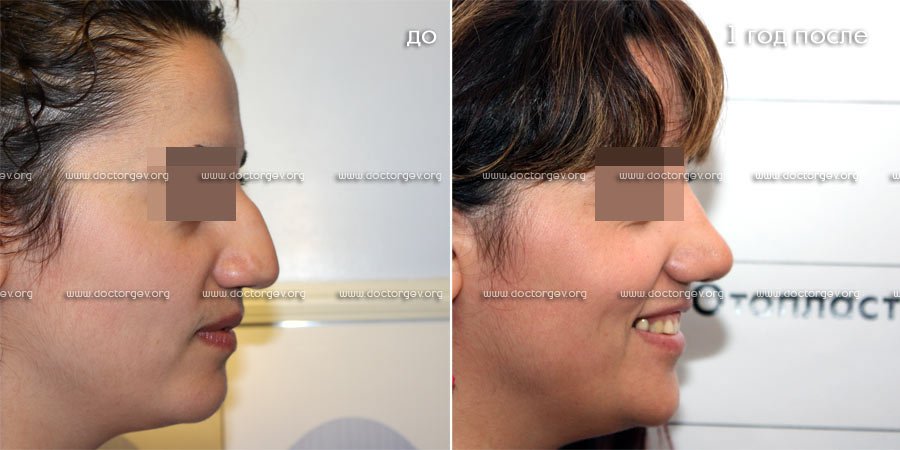
Another clinical case began with a visit from a young woman whose primary aesthetic concern was the shape of her nose in profile — a large, prominent hump and a drooping tip deprived her facial features of softness. The patient noted that when smiling, the tip “drooped” downward, making her facial expression look more severe and aged. In addition, during the medical history taking, I identified complaints of nasal breathing difficulties, especially at night.
Initial anatomical features (before surgery)
Upon examining the patient in profile, I identified the following anatomical markers:
- Nasal dorsum: High, pronounced osteocartilaginous hump with a sharp transition, which visually overloaded the middle third of the face.
- Nasal tip: Significantly drooped downward, with an acute nasolabial angle and insufficient projection. The weakness of the tip cartilaginous framework led to hypermobility of the tip during facial expressions.
- Nasal septum: Deviation of the quadrangular cartilage, which significantly narrowed one of the nasal passages and caused functional impairment.
- Skin quality: Medium density with good elasticity. This is a favorable factor for tissue contraction; however, it requires me to perfectly smooth the bone edges after hump removal.
Surgical course and objectives
My work was aimed at creating a balanced, natural female silhouette of the nose and fully restoring its function.
During the closed rhinoseptoplasty, I performed a complex of maneuvers:
- Hump removal: Carefully remodeled the bony and cartilaginous sections of the nasal dorsum, forming a smooth, elegant profile line.
- Septoplasty: Corrected the deviated areas of the septum, returning it to a central position and opening the airways.
- Nasal tip surgery: I performed a rotation (elevation) of the nasal tip upward and reinforced its structure using cartilaginous autografts. This was necessary to create a reliable support that would hold the tip in the correct position and prevent it from drooping even with the widest smile.
Result after 1 year
The “After” photo shows a stable result after 1 year. The tissues have fully adapted to the new framework.
The patient’s profile has become incredibly graceful and harmonious: the nasal dorsum is now perfectly straight, and the elevated tip has opened up a beautiful nasolabial angle. Note the photo on the right — the patient is smiling openly and sincerely, while the nasal tip maintains its ideal shape and projection without dipping downward. The face looks noticeably softer, gentler, and younger. The nasal congestion problem is completely resolved, and breathing is free. My patient is very pleased with the result and happily shares her new smile.