
A young man sought a consultation with a classic request that combined aesthetics and functionality. The patient was concerned about the massiveness of his nose, a prominent hump, as well as nasal breathing issues, which are often the result of deformed internal structures.
Initial Anatomical Features
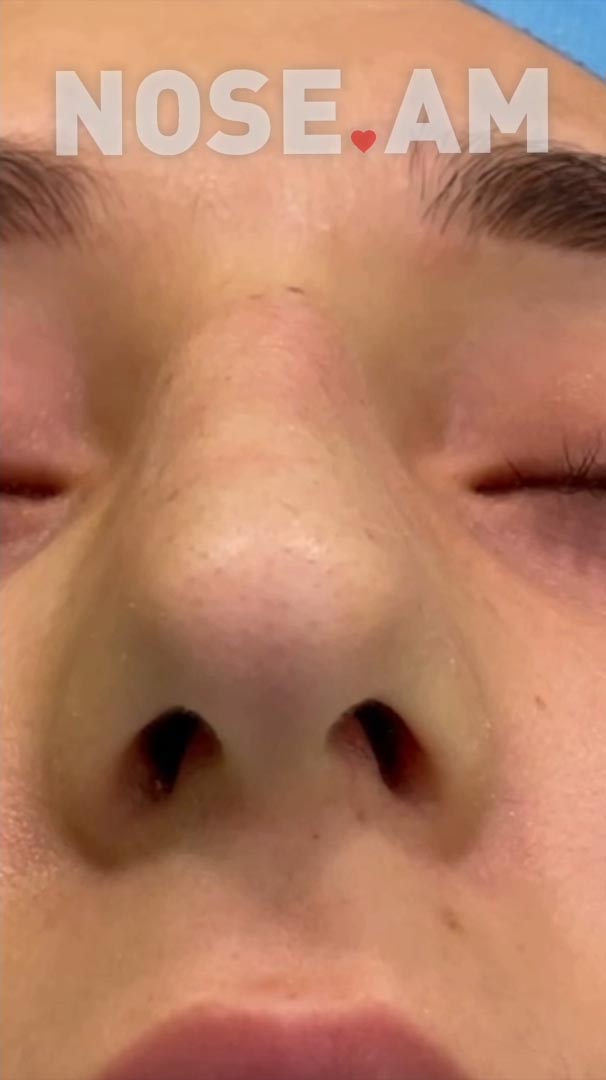
After a detailed study of the baseline characteristics, I identified several key tasks. The “Before” images clearly show a massive osteocartilaginous base: the high dorsum with a hump weighed down the profile, making the facial features look excessively harsh. The nasal tip was wide, bulbous, and slightly drooped. Furthermore, an examination from the base of the nose (basal view) clearly revealed nostril asymmetry and deviation of the caudal septum. It was this deviation that blocked the free flow of air, causing the patient daily functional discomfort. A specific surgical challenge for me was the typical male anatomy: dense, thick, and porous skin. Working with this tissue type requires a special technique and a strong structural approach; otherwise, the refined contours of the new cartilaginous framework simply will not show through the thickness of the dermis.
Course of the Operation
I performed a comprehensive rhinoseptoplasty. My main goal was to create a harmonious yet strictly masculine nose — without an over-rotated tip or an excessive dorsal scoop — to preserve the patient’s strong-willed facial character. I delicately removed the hump, shaping a smooth, straight, and masculine profile line. To address the nasal tip, I constructed a reliable cartilaginous framework, which allowed me to refine it, elevate it to a physiologically correct angle, and ensure a stable projection, even considering the pressure of the thick skin. Naturally, I carried out extensive work on the septum: aligned the axis of the nose, corrected the asymmetry of the nostrils, and completely restored the proper anatomy of the airways.
The Result
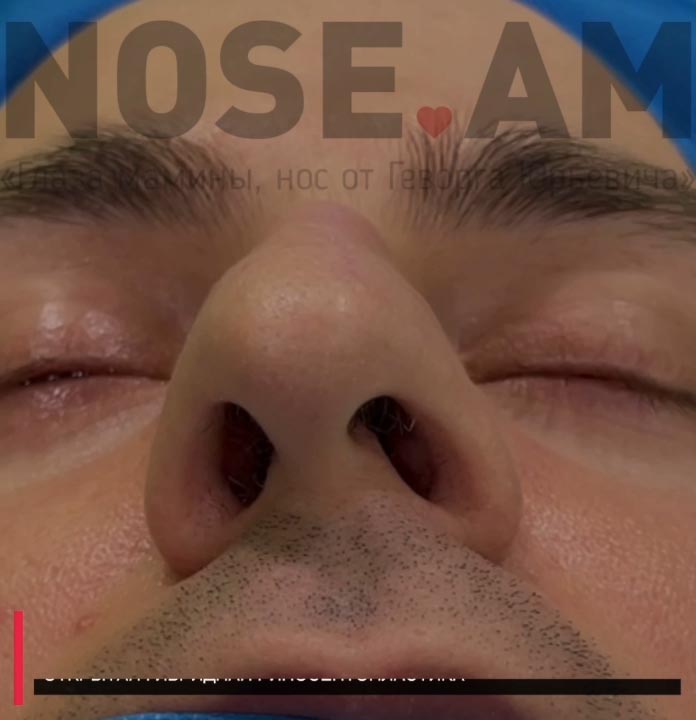
In the “After” images taken right on the operating table, our result is already visible. The profile has become straight and aesthetic, the massiveness is gone, and the tip has acquired well-defined yet natural contours. The patient’s face was instantly transformed — it looks more harmonious, fresh, and proportional. Most importantly, we did not just achieve an excellent visual effect, but also restored the patient’s full, unobstructed breathing. The perfect balance of health and aesthetics has been achieved.