
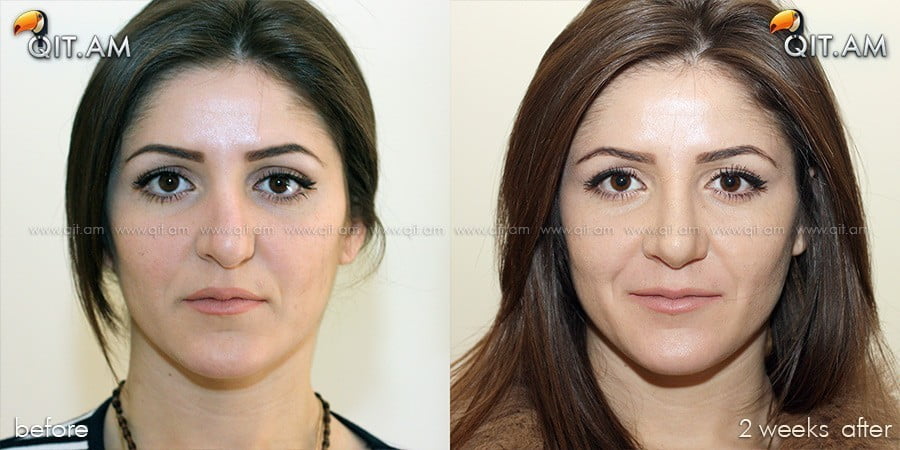
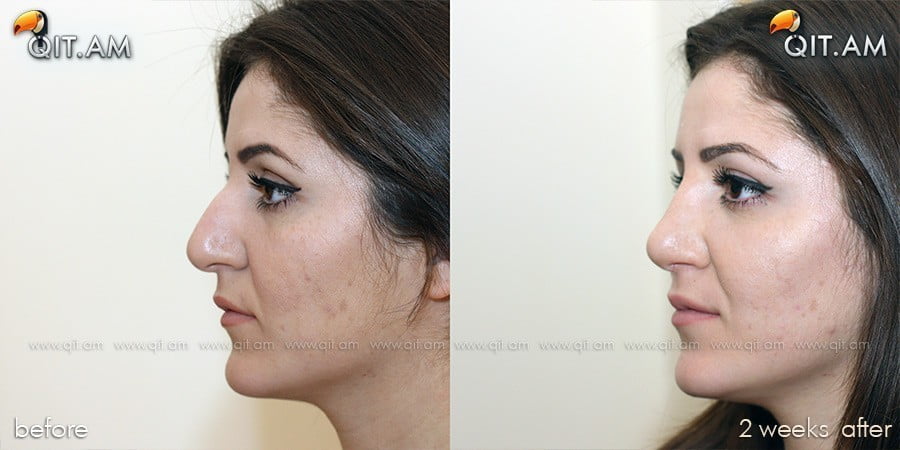
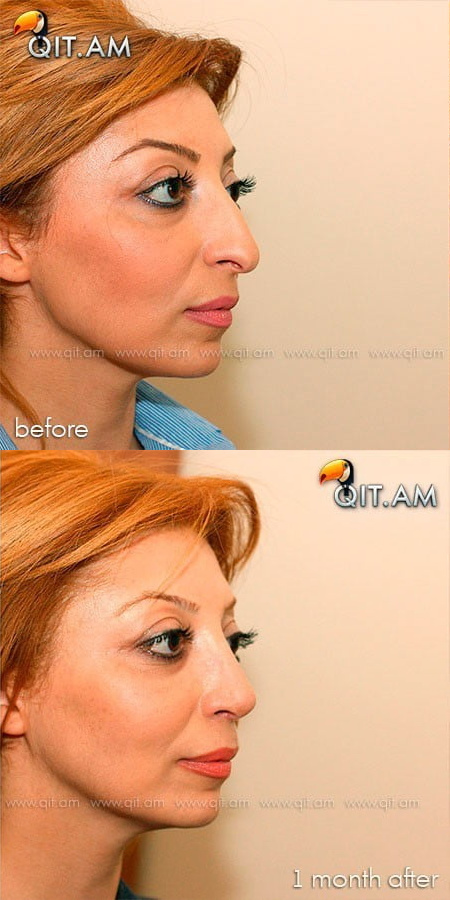
A young, very pleasant patient came to me for a consultation, wishing to harmonize her facial features. Her main aesthetic complaints were a pronounced hump and a rather bulky, drooping nasal tip, which visually weighed down the profile and gave the face a slightly tired appearance.
Initial Anatomical Features
Upon a detailed frontal examination, I also noted a widened nasal bridge and a slight axial asymmetry—a typical picture where aesthetic discomfort is frequently accompanied by hidden or obvious nasal breathing impairments, requiring mandatory functional correction.
Evaluating the baseline anatomical data, I noted the patient’s thick skin in the nasal tip area. For me as a surgeon, this is always a specific professional challenge: thick skin tends to obscure the newly created definition, and forming an elegant, well-defined tip beneath it requires truly precise, jewelry-like, and reliable structural work on the cartilaginous framework.
Surgical Progress and Objectives
During the surgery, my goal was not merely to remove the hump, but to create completely new, smooth, and light lines, while preserving the young woman’s natural look and individuality. I performed a comprehensive rhinoseptoplasty:
- Straightened the nasal septum to fully restore free breathing.
- Gently lowered the dorsal projection, eliminating the hump, and performed an osteotomy to narrow the bony vault.
- I paid special attention to the nasal tip—structurally reshaping it, rotating (lifting) it to a correct, feminine angle, and delicately narrowing the cartilages.
Result after 2 weeks
In the photos presented, you can evaluate the result just 2 weeks after the surgery. Despite the fact that at such an early stage the tissues are still undergoing the healing phase and natural postoperative swelling persists (especially in the tip area), the transformation is already obvious.
The profile has become soft, straight, and harmonious, and the previous heaviness is gone. In the frontal view, the face looks significantly fresher, younger, and more refined, and the gaze has become more open. Nasal breathing is restored, and what is the greatest reward for me—my patient is sincerely happy to see her new, harmonious reflection in the mirror.
&description=&image=https://new.nose.am/wp-content/uploads/2026/07/119_case_2_preview-1.jpg)