
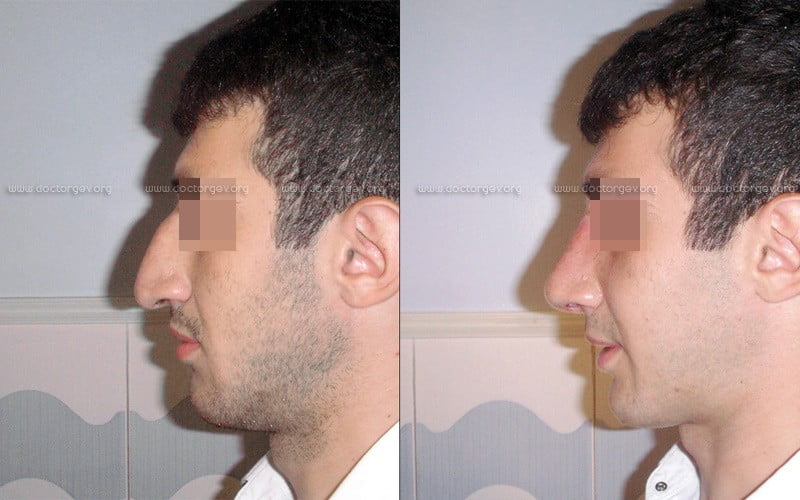
A young man came to my consultation with a request for nose shape correction. The main source of his aesthetic discomfort was a very large, sharply defined hump that dominated his face and made the profile look visually heavy, harsh, and even aggressive. In addition, during the examination, the patient confirmed my suspicions that his free nasal breathing was impaired — a consequence of a deviated internal nasal septum.
Initial anatomical picture (before surgery)
Male rhinoplasty is always a work of increased precision. Here, it is important not just to remove excess tissue, but also to prevent feminization of the face (excessive sloping of the bridge or over-rotation of the tip).
When analyzing the patient’s profile, I highlighted the following features:
- Nasal bridge: a massive, high osteocartilaginous hump with a steep break was determined, significantly disrupting the overall proportions of the face.
- Nasal tip: due to the hypertrophy of the cartilaginous framework and the influence of the low-set nose architectonics, the tip was severely drooped downwards (hooked shape). The nasolabial angle was acute, which visually lengthened the nose and gave the face a gloomy expression.
- Anatomical structure: a powerful bone apparatus and dense cartilage required a large-scale, yet extremely precise reconstruction.
My main task was to remove the aesthetic defect and restore breathing, while definitely preserving the strong, masculine, and natural character of the profile.
Surgery progress and surgical tasks
The operation was simultaneous (combined). As the first step, I performed a septoplasty — straightened the deviated parts of the nasal septum, thereby completely clearing the airways and restoring full aeration.
Then I proceeded to the aesthetic stage:
- Performed a gentle, controlled osteotomy and resection of the osteocartilaginous excess of the nasal bridge. It was extremely important to stop exactly at the level of a straight line so that the profile remained classically masculine, without concavity.
- Conducted reconstruction and stabilization of the nasal tip. I changed its tilt angle, raising it to the optimal 90–95 degrees for men, and securely fixed it with cartilaginous autografts to eliminate the risk of its drooping under the influence of facial expressions in the future.
Surgery result
In the postoperative photo, we see a stunning transformation. I managed to completely eliminate the huge hump, creating a perfectly straight, strong nasal bridge. The tip took its anatomically correct position — it no longer points downward, and the nasolabial angle looks harmonious and natural.
Despite the significant scale of volume reduction, the nose looks completely “native,” harmonizing with the chin, forehead line, and overall facial features. The patient’s face began to look more open, intelligent, and attractive, while completely maintaining its masculinity. The young man’s quality of life reached a new level: the nose breathes freely and fully. The patient is completely satisfied with the result, and for me, this case is an excellent example of how surgery changes not only a man’s appearance but also his inner self-perception.