
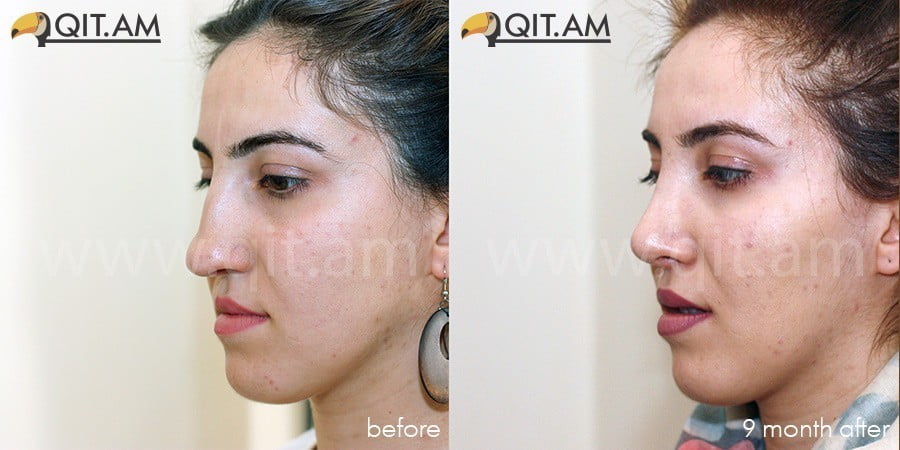
A charming young woman approached me wishing to make her facial features softer and more harmonious. Her primary aesthetic complaints were a pronounced hump and a heavy, droopy nasal tip. In addition, during the examination phase, I diagnosed a functional problem — a deviated nasal septum that obstructed full nasal breathing, which meant complex work lay ahead of me.
Initial Anatomical Features
Upon detailed analysis of the baseline data before the operation, I noted the following nuances:
- A massive osteocartilaginous hump that visually weighed down the profile.
- The nasal tip lacked refinement and drooped slightly, giving the face a somewhat tired and stern appearance.
- Sufficiently thick skin. For me as a surgeon, this is always a challenge: such anatomy means that especially filigree work with structural cartilages is required. It was necessary for me to create a durable supporting framework to achieve an expressive, chiseled tip that would not “flatten out” under the thickness of soft tissues.
Surgical Course and Objectives
During the operation, my primary task was not just to remove excess volume, but to find the perfect aesthetic balance. I performed a closed rhinoseptoplasty:
- First and foremost, I straightened the septum to restore flawless breathing.
- Then, I delicately lowered the projection of the nasal dorsum, completely eliminating the hump.
- I paid special attention to the rotation and modeling of the tip — it was gently lifted, narrowed, and securely fixed.
Result After 9 Months
In the photograph taken 9 months after the surgical intervention, the final result can be evaluated. The profile has become smooth, neat, and incredibly feminine. The nasal dorsum acquired a natural, smooth contour, and the updated, slightly upturned tip visually refreshed the face, removing the shadow of fatigue.
My patient now breathes fully and sincerely rejoices at her new, harmonious reflection in the mirror, which for me is the best confirmation of a successfully completed job.
&description=&image=https://new.nose.am/wp-content/uploads/2026/07/112_case_1_preview.jpg)