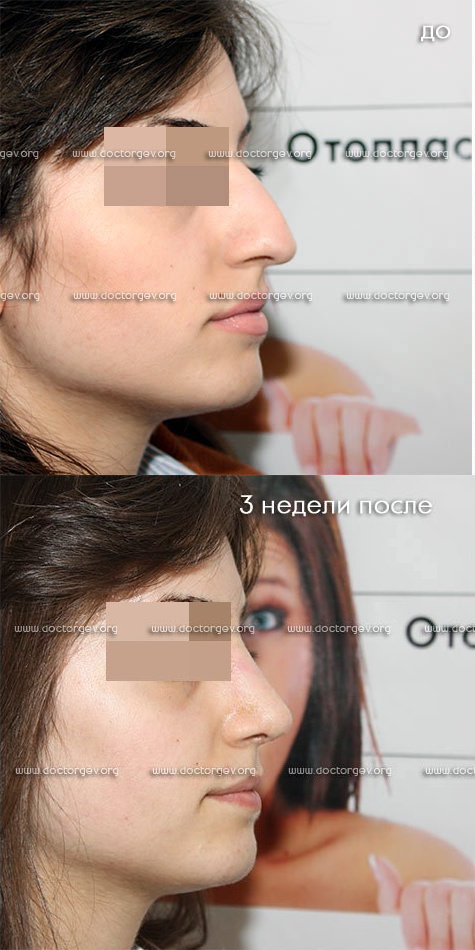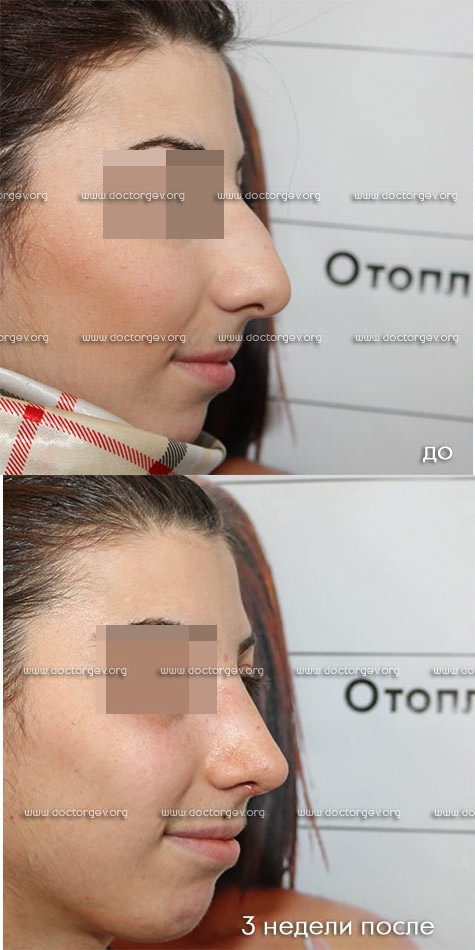

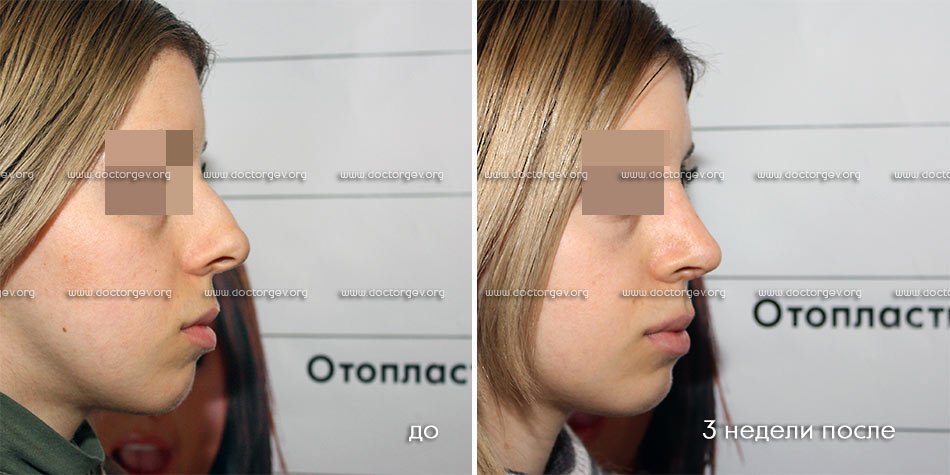
A young female patient, who was categorically dissatisfied with the appearance of her nose in profile, came to me for a consultation. The main aesthetic problem was a pronounced osteocartilaginous hump, which visually weighed down the middle third of the face and disrupted the overall harmony of the features.
Initial clinical presentation
Upon detailed examination “Before” in profile, I recorded the following anatomical features:
- Nasal bridge: a noticeable bony protrusion (hump) transitioning into the cartilaginous section was identified.
- Nasal tip: had insufficient projection and was slightly dropped downward, which, combined with the hump, visually made the nose look excessively long.
- Skin quality: the patient has fairly thin skin in the area of the nasal bridge. For me as a surgeon, this is always a signal for extreme, surgical precision: on thin skin, after the swelling subsides, the slightest imperfections of the work on the bone can become visible, so smoothing the profile must be absolutely flawless.
- Functional component: during anterior rhinoscopy, a deviated nasal septum was revealed, which caused periodic difficulty breathing on one side.
Tasks and nuances of the surgery
My goal was to perform a closed rhinoseptoplasty for gentle shape correction without visible external scars. Two key tasks had to be solved: to restore full nasal breathing and to harmonize the profile, making it soft and feminine.
During the operation, I first performed a septoplasty — leveled the deviated parts of the septum. Then I moved on to the aesthetic stage: delicately resected (removed) the osteocartilaginous hump and performed a thorough refinement of the nasal bridge, achieving a perfectly straight line. The nasal tip was carefully modeled: I changed its rotation, slightly lifting it upward to form a beautiful, open nasolabial angle.
Early result after 3 weeks
The presented “After” photographs capture a very early postoperative result — only 3 weeks have passed. At this stage, the tissues still retain pronounced swelling (especially in the tip area and above it), which will gradually subside over the coming months, making the lines even more sculpted.
However, the radical transformation is already obvious now. The heavy hump has been completely eliminated, the line of the bridge has become flawlessly straight, smooth, and elegant. The slightly elevated nasal tip made the face visually lighter, softer, and younger, advantageously emphasizing the line of the lips and chin. Nasal breathing has already fully recovered. The patient feels great and is incredibly happy to see her new, harmonious profile.