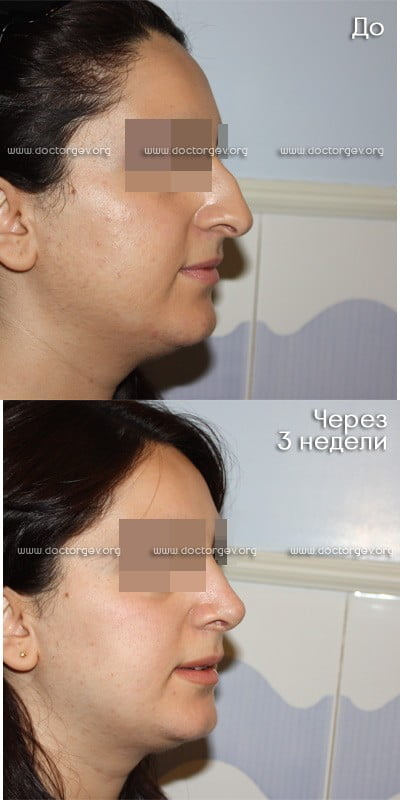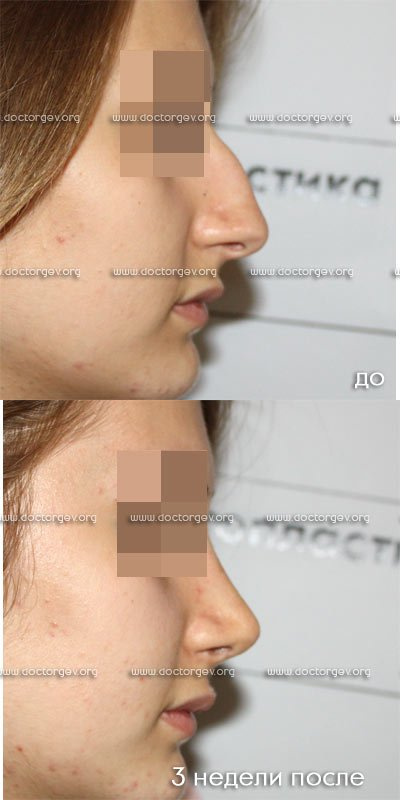

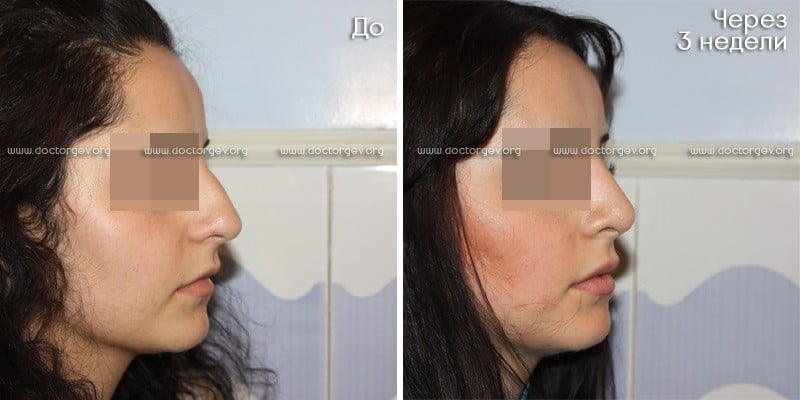
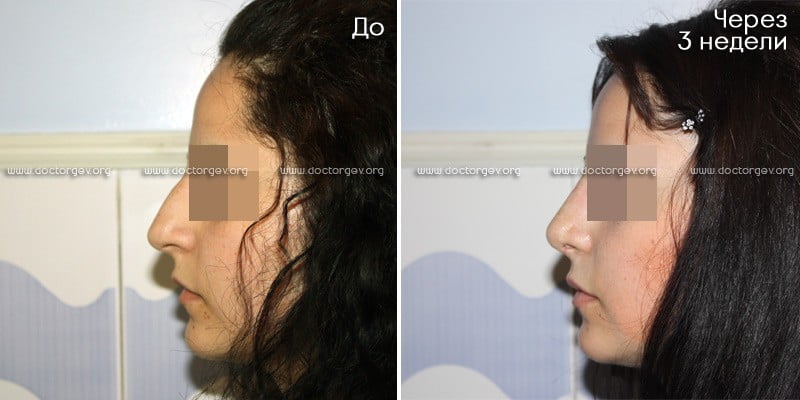
A young female patient approached me with a distinct request to change the shape of her nose. Her main desire was to get rid of a large, sharp dorsal hump that dominated her face and deprived her profile of femininity. Due to this anatomical feature, the face appeared stricter and older than it actually was.
Initial Anatomical Features (Before)
During the examination and profile analysis of the patient, I highlighted the following nuances:
- Nasal dorsum: The presence of a high, sharp osteocartilaginous hump. It visually elongated the nose and created a sharp transition from the bridge of the nose.
- Nasal tip: It had a tendency to droop, lacking graceful projection and definition. The heavy dorsum visually “pressed” on the tip, exacerbating the disproportion.
- Skin quality: The patient’s skin is quite thin in the area of the nasal dorsum. For a surgeon, this imposes a huge responsibility: on thin skin, after redraping, the slightest flaw or unevenness of the cartilaginous framework is noticeable. The work must be absolutely smooth and jewel-precise.
Surgical Procedure and Objectives of the Surgeon
My key task was to soften the facial features, make the profile refined and smooth, but at the same time fully preserve naturalness so that no one would guess the fact of surgical intervention.
During the operation, I performed a careful osteotomy and resection of the cartilaginous part of the hump, gently lowering the nasal dorsum to an ideal straight line. After that, I proceeded to model the nasal tip: I changed the position of the cartilaginous structures, slightly rotated (lifted) it upwards, and fixed it in a new, harmonious position. This allowed to visually shorten the nose and open up the face.
Result After 3 Weeks (After)
The photographs capture a very early postoperative result — only 3 weeks have passed. For such a short period, the picture is excellent:
- The hump is completely eliminated: the dorsal line has become flawlessly straight, graceful, and feminine.
- Nasal tip: it has lifted, become neat and chiseled, and the previous visual heaviness is gone.
- The patient’s face: was instantly transformed — the look became more open, and the general facial features acquired incredible softness and tenderness.
It is worth noting that at the 3-week mark, dense postoperative edema still persists on the nasal tip and bridge, which will gradually subside over several months, making the nose even more miniature and defined. Nevertheless, the patient is already completely delighted with her new, harmonious profile.