
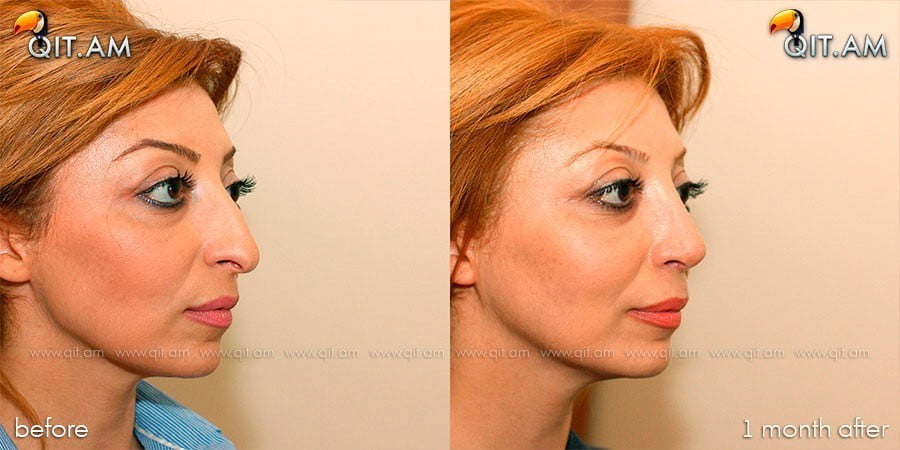
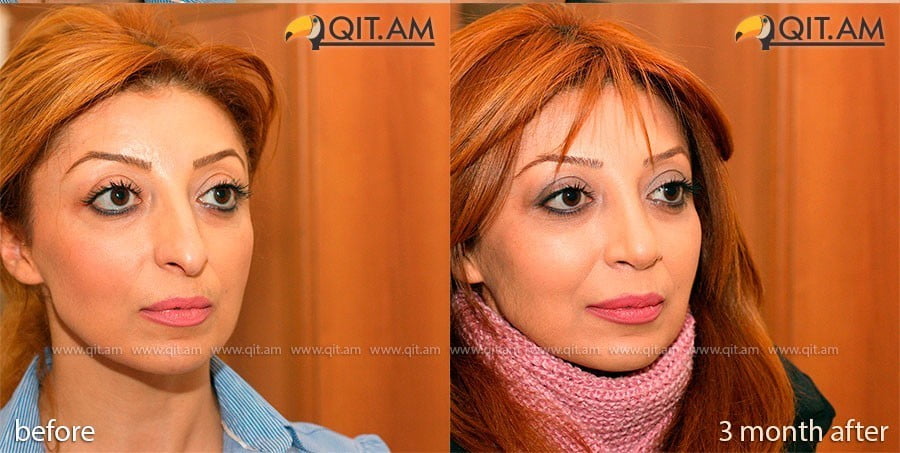
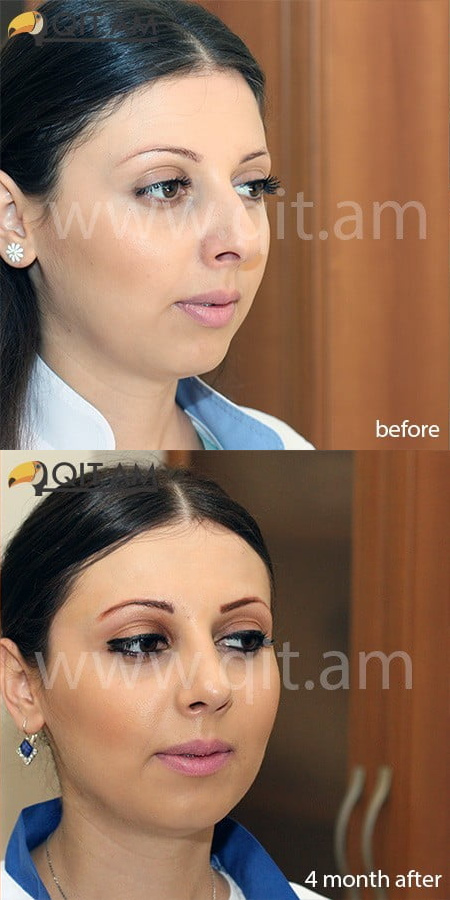
In search of internal and external harmony, a charming patient came to see me. Her main aesthetic complaints were a pronounced hump, excessive width of the nasal bridge, and a drooping tip. This anatomical pattern visually lengthened the nose, weighed down the middle third of the face, and gave it a slightly tired, older appearance.
Initial Anatomical Features
Upon a detailed examination, I also diagnosed a deviated nasal septum, which was expectedly accompanied by complaints of nasal breathing difficulties.
Studying the baseline data, I noticed that the patient had rather thick skin. For me as a surgeon, this implies the need for precise, filigree work with the cartilaginous framework: for a graceful and well-defined contour of the new tip to emerge through such skin, special skill and a structural approach are required.
Surgical Course and Objectives
My goal was not just to reshape, but to create a nose that perfectly integrates into the natural architecture of the face while preserving its individuality. I performed a functional rhinoseptoplasty.
- During the surgery, I carefully removed the hump, performed an osteotomy to narrow the bony pyramid, and created a smooth, straight bridge line.
- I paid special attention to the nasal tip: I shortened it, established the correct projection, and delicately lifted it, creating a beautiful, feminine angle.
- Concurrently, I straightened the septum, completely restoring physiological breathing.
Result (1 and 3 Months)
In the photographs, you can evaluate the result of my work 1 and 3 months after the surgery. The patient’s face has transformed incredibly: it seems to have opened up, looking fresher, softer, and younger.
We achieved an elegant profile without losing naturalness. My patient is genuinely pleased with her new reflection in the mirror and the fact that she can now breathe freely and deeply.
&description=&image=https://new.nose.am/wp-content/uploads/2026/07/120_case_1_preview-1.jpg)