
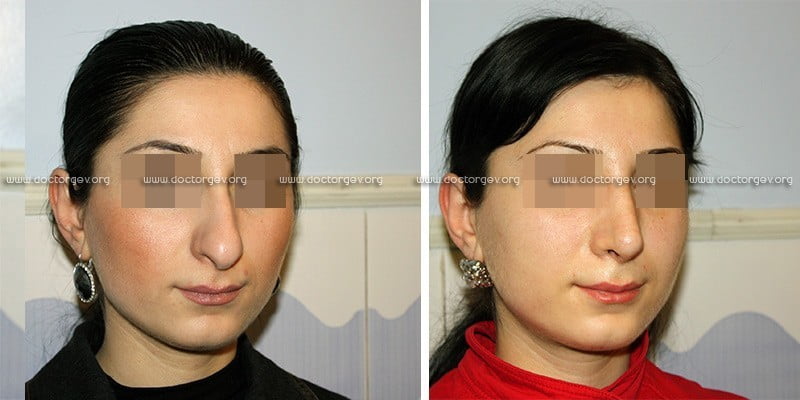
A patient approached me whose primary dream was to radically soften her facial features. A large, dominant nose disrupted the overall proportions, making her appearance overly stern and masculine. In addition to aesthetic discomfort, the young woman suffered from chronic nasal congestion—the deviated internal structure significantly restricted the free flow of oxygen.
Initial Anatomical Features (“Before” Photos)
During the detailed preoperative analysis, I noted a number of complex anatomical nuances that required a comprehensive surgical intervention:
- Pronounced asymmetry and deviation of the nasal axis. The nose was noticeably shifted to the side, indicating a severe septal deviation.
- Massive osteocartilaginous hump. It made the middle third of the face look heavy and created a harsh, broken line of the nasal bridge.
- Significant ptosis (drooping) of the nasal tip. The tip was excessively long, heavy, and downward-facing. This shape visually overloaded the face, made the expression look frowning, and added extra years to a young woman.
- Dense skin of medium thickness. This required me to create a well-defined, stable cartilaginous framework that would beautifully drape over the new contours and prevent the nasal tip from drooping under the weight of tissues over time.
Surgical Procedure and Goals
To address these issues, I performed a simultaneous functional and aesthetic rhinoseptoplasty.
The first and most crucial stage was septoplasty: I completely reconstructed the deviated nasal septum, aligned it along the central axis, and cleared the nasal passages to restore perfect breathing.
Then I proceeded to the meticulous aesthetic work. I carefully resected the excess bone and cartilage tissues of the nasal bridge, completely eliminating the hump and narrowing the nasal bones to give the bridge a graceful silhouette. Special attention had to be paid to the nasal tip: I shortened its length, performed a delicate rotation (lifted it upwards), and secured it in a new, anatomically correct position. All cartilaginous structures were meticulously sculpted to smooth the transitions and create soft, feminine lines.
Correction Result (“After” Photos)
The result of the operation clearly demonstrates how changing the shape of the nose can transform the entire face, making its features more refined and harmonious:
- Perfect axis and symmetry: the nose is aligned strictly in the center of the face, and the bridge has become smooth and neat.
- Rejuvenation effect: the lifted and shortened nasal tip completely changed the perception of the face. The former sternness disappeared, the look became more open, and the overall appearance gained lightness, freshness, and a youthful aesthetic.
- Functional success: most importantly, in addition to external beauty, my patient finally got rid of nasal drops and can breathe freely.
The patient is happy, her face has found its long-awaited softness and balance, and the nose itself looks absolutely natural, as if created this way by nature.