
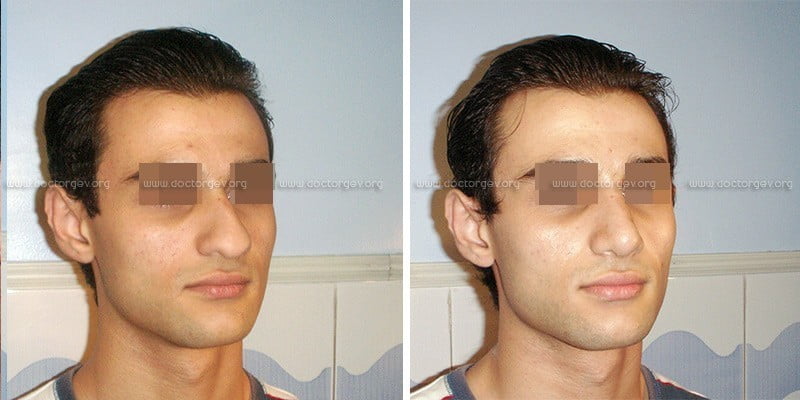
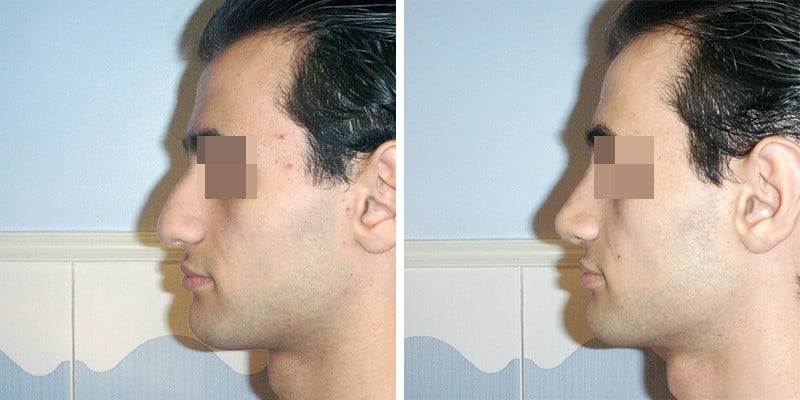
A young man came to me for a consultation wishing to get rid of a large dorsal hump and correct the shape of his nose, which gave his face an overly harsh and heavy expression. In addition to aesthetic dissatisfaction, the patient noted problems with respiratory function — constant nasal congestion on one side, which worsened during physical exertion.
Initial Anatomical Features (“Before” Photos)
When analyzing the face in profile and three-quarter views, I identified key areas that required surgical correction:
- Nasal dorsum: a high, massive osteocartilaginous hump (“aquiline” profile) was identified, severely disrupting the proportions of the face.
- Nasal tip: was significantly drooping downward, forming an acute, closed nasolabial angle. This visually lengthened the nose and added weight to the middle third of the face.
- Nasal septum: had an internal deviation caused by uneven growth of cartilaginous structures, which was the cause of the breathing difficulties.
Specifics of male rhinoplasty: Working with a male face requires a special delicacy from the surgeon. My key task was to remove excess tissue, but under no circumstances allow feminization of the face — the dorsum should not be made concave, and the tip should not be too upturned. The nose must remain strong, straight, and masculine.
Surgical Procedure and Goals
The operation was performed under general anesthesia and included both functional and aesthetic stages.
First, I performed a septoplasty, correcting the nasal septum deviation and restoring the symmetry of the internal airways. Then I proceeded to aesthetic modeling: I performed a delicate reduction of the bony and cartilaginous components of the hump. The nasal dorsum was leveled strictly in a straight line. To correct the tip, I applied the structural rhinoplasty technique — lifting it slightly, modeling a refined shape, and securely fixing it with cartilage grafts at a right nasolabial angle (~90 degrees), which is harmonious for men.
Surgical Outcome (“After” Photos)
In the postoperative photographs, we can see a harmonious, stable result. The changes look completely natural, as if the patient was born with such a nose:
- Masculine profile: the nasal dorsum became perfectly straight, without a hint of a hump or excessive curvature.
- Balanced tip: the nose no longer looks long or droopy, and the tip is fixed in an anatomically correct position.
- Overall facial harmony: the young man’s face retained its character, but his gaze became more open, and the overall appearance became lighter, more refined, and noble.
The functional outcome of the operation was also fully achieved: nasal breathing was completely restored, the patient was relieved of constant congestion, and is fully satisfied with the result.