
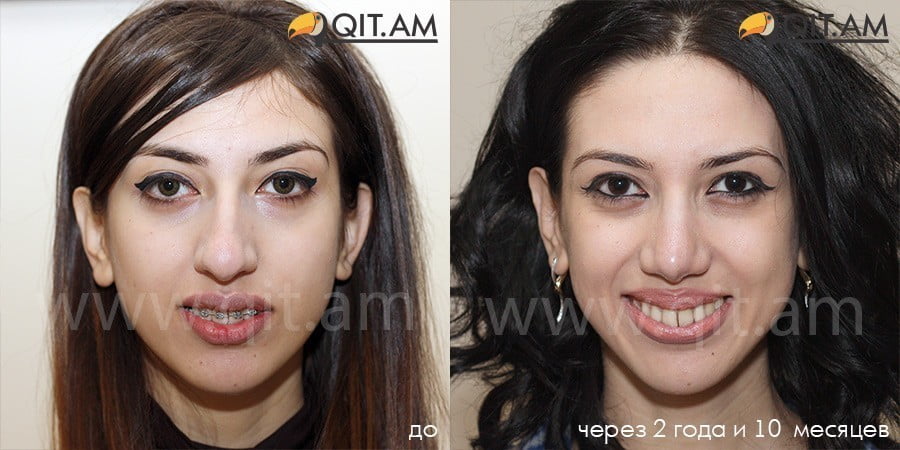
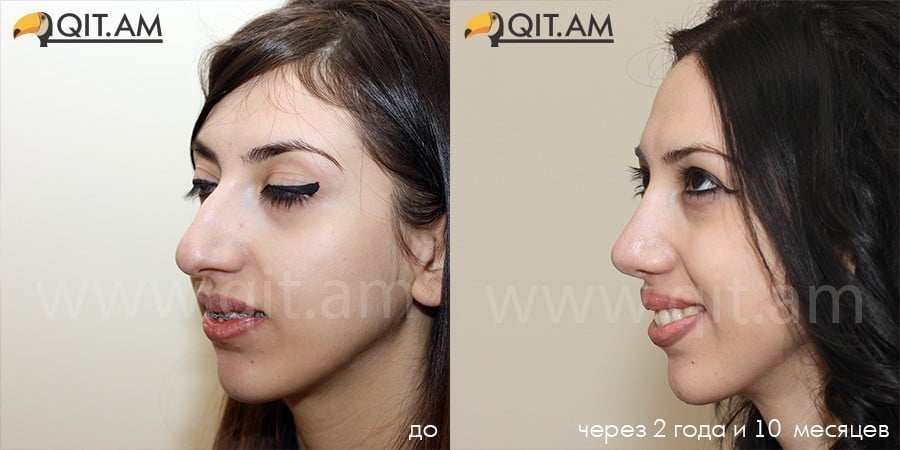
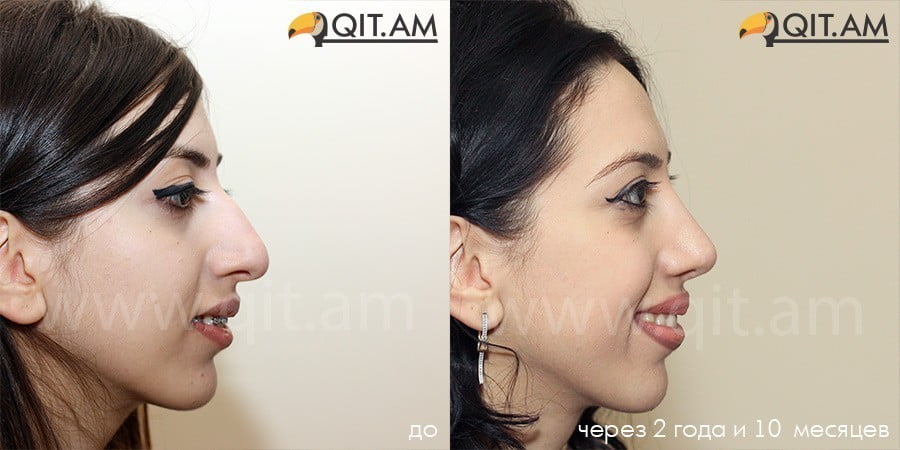
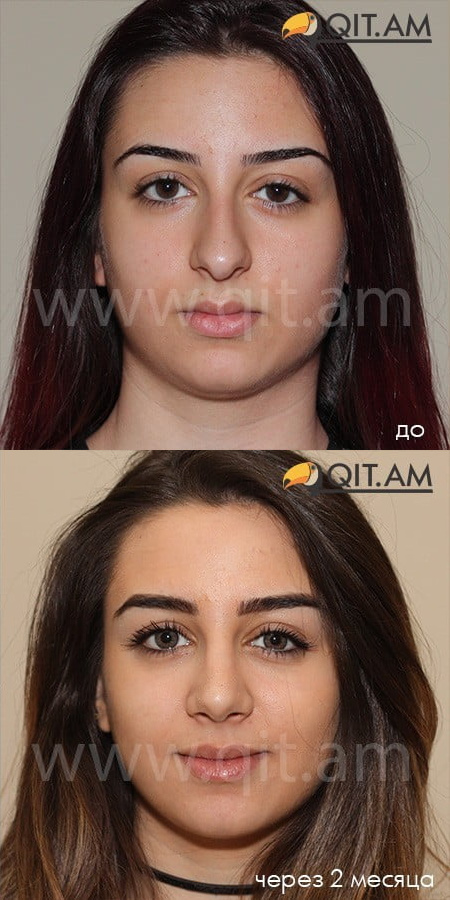
A young female patient undergoing orthodontic treatment sought my help to harmonize her facial features. The presence of a braces system always requires a plastic surgeon to pay special attention to future facial proportions. Her main complaints concerned pronounced aesthetic disharmony: the patient was bothered by a large hump, excessive nasal length, and a visually heavy, drooping tip.
Initial Anatomical Findings (Before Surgery)
During the examination and profile analysis, I identified several key anatomical features that required precise, jewel-like correction:
- Nasal bridge: a high osteocartilaginous hump was present, disrupting the smoothness of the profile.
- Nasal tip: was significantly drooping (the “hooked nose” effect), over-projected, and appeared bulky. When smiling, the tip dropped even lower, enhancing the visual length of the nose and giving the face a more severe, fatigued look.
- Skin quality: moderately thick skin in the tip area required extremely precise work on the underlying cartilaginous structures to ensure the reshaped framework would be well-defined and not blur over time.
My main goal was not simply to reduce the size of the nose, but to completely harmonize the facial features, making them softer, more feminine, and open.
Surgical Procedure and Technical Nuances
During the rhinoseptoplasty, I performed a careful reshaping of the osteocartilaginous framework — gently removing the hump and sculpting a straight, elegant nasal bridge. Special attention was paid to the tip area: rotation and repositioning of the nasal tip cartilages were carried out for its de-projection (shortening) and delicate lifting. To prevent future drooping of the tip and secure it in the correct position, I reconstructed a reliable support system.
Result After 2 Years and 10 Months
The photographs demonstrate a long-term, highly stable result — almost 3 years after the surgical intervention. During this time, the tissues have fully recovered, all residual swelling has resolved, and we can observe the final silhouette.
I sculpted a perfectly straight, refined nasal bridge with a smooth transition to a neat, lifted tip. The nasolabial angle reached its aesthetic ideal. The nose became proportional to the face, and the visually “heavy” profile effect disappeared. The patient’s gaze became more open, and her smile — light and natural. The patient is completely satisfied with the result, which enhanced her natural beauty while preserving her individuality.
&description=&image=https://new.nose.am/wp-content/uploads/2026/07/006_case_3_preview.jpg)