
A young man approached me seeking a solution to a combined problem. He was concerned about a pronounced aesthetic imbalance — a large hump and a visually long nose, which gave his face an overly harsh expression. In addition, the patient complained of constant difficulty in nasal breathing, which forced him to use vasoconstrictor drops regularly.
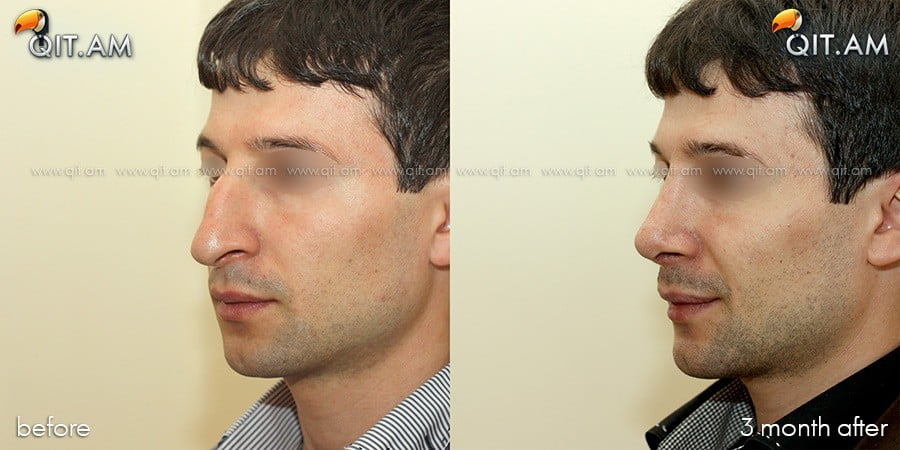
Initial Anatomical Features (“Before” Photos)
When analyzing the face in a three-quarter view (semi-profile), I identified the following key aspects for surgical intervention:
- Nasal dorsum: a noticeable osteocartilaginous hump was present, distorting the overall facial proportions.
- Nasal tip: due to the anatomical characteristics of the cartilages, it was drooped downward, forming an acute nasolabial angle. This visually lengthened the nose and made the middle third of the face look heavy.
- Nasal septum and skin: the patient was diagnosed with a pronounced deviation of the nasal septum, blocking normal airflow. The skin was of medium thickness, requiring jeweler’s precision when modeling new contours.
Surgical Strategy and Course of the Operation
Working with a male nose requires utmost delicacy from the surgeon. It is categorically unacceptable to allow a “doll-like” appearance, excessive dorsum curvature, or an overly upturned tip. My main goal was to create a strong, strictly straight, and natural male profile.
I performed a comprehensive closed rhinoseptoplasty. In the first stage, I carried out a septoplasty — correcting the deviated cartilaginous and bony sections of the septum, completely restoring the architectonics of the internal nasal passages. During the aesthetic stage, I carefully reduced the hump, building a flawlessly straight dorsal line. Then, a gentle rotation of the nasal tip was performed: I elevated it and fixed it in an anatomically correct position, forming a harmonious male nasolabial angle (about 90 degrees).
Result After 3 Months (“After” Photos)
The postoperative photographs record an intermediate result after 3 months. At this stage, a moderate postoperative tissue edema is still present, which will gradually subside for up to a year, but the key changes are fully visible:
- Profile: the nasal dorsum has become absolutely straight, noble, and masculine, without the slightest hint of a hump.
- Nasal tip: no longer sags, having gained a well-defined shape and secure cartilaginous support. The nose looks more compact and neat.
- Overall balance: the patient’s face looks visually refreshed; the features have become more harmonious and balanced in relation to the chin and forehead line. The nose looks as if the surgery was never performed.
The patient notes a colossal improvement in the quality of life: nasal breathing has been fully restored, and the updated, masculine profile has given him even more self-confidence.
&description=&image=https://new.nose.am/wp-content/uploads/2026/07/102_case_1_preview.jpg)