
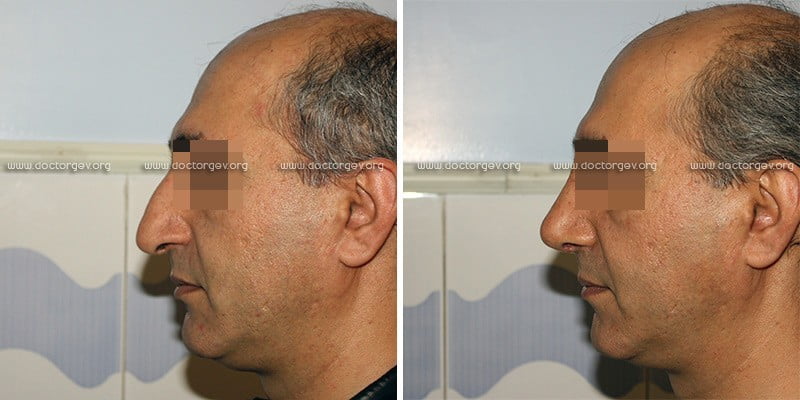
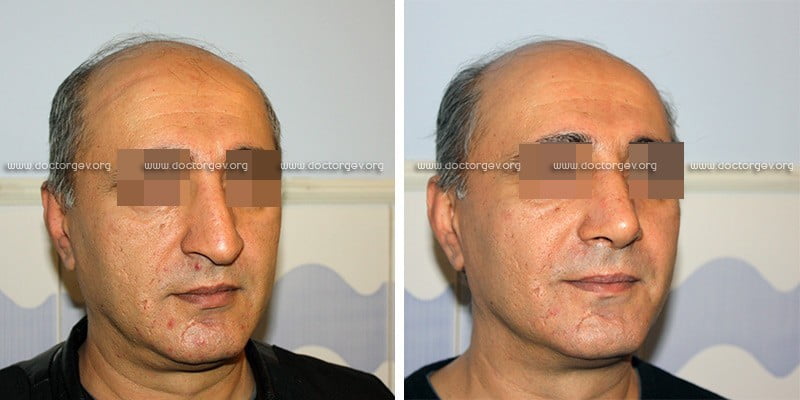
A mature man came to me for a consultation. His main requests included both the aesthetic improvement of the nose shape and the resolution of a serious functional problem — severe, chronic nasal congestion that interfered with a fulfilling life and healthy sleep.
Initial anatomical features (before surgery)
Male rhinoplasty always requires a special, conservative approach: here it is fundamentally important to preserve masculine facial features, avoiding excessive reduction or over-rotation of the tip. In this case, I faced a complex set of anatomical features:
- Nasal axis and septum (frontal/three-quarter view): A pronounced deviation (curvature) of the entire nasal pyramid to the side was observed. This is a clear sign of severe post-traumatic or congenital deformation of the quadrangular cartilage (septum), which almost completely blocked one of the nasal passages.
- Nasal bridge: The presence of a large, high osteocartilaginous hump, which made the profile heavy and visually added age to the patient.
- Nasal tip: Massive, drooping downwards, with firm fixation. Combined with the hump, such a tip created a hook-like nose shape, giving the facial expression excessive harshness.
- Skin quality: Thick, porous, oil-prone skin. Working with such skin requires creating a very stable, powerful cartilaginous framework, otherwise, under the weight of heavy soft tissues, the result may “blur” over time.
Surgical procedure and objectives
To achieve the set goals, I performed a simultaneous rhinoseptoplasty. My work was divided into two key stages:
- Functional stage (septoplasty): I performed a deep reconstruction of the nasal septum, removed the deviated fragments, and returned it to a strictly midline position, fully restoring the architecture of the nasal passages.
- Aesthetic stage: A careful osteotomy was performed to eliminate the hump and align the deviated nasal axis along the centerline of the face. I paid special attention to the tip: lifting it to an optimal angle for men (about 90 degrees) and reinforcing it with cartilage grafts to counteract the contraction of thick skin. I intentionally left the bridge straight and strong, preserving a harmonious masculine profile.
“After” Result
The postoperative photographs clearly show the balance between functionality and aesthetics:
- In frontal and three-quarter views: The nasal axis has become perfectly straight; the nose is now centered relative to the midline of the face. The former asymmetry is gone.
- In profile: The hump is completely eliminated. The nasal bridge has become straight, and the tip has taken an anatomically correct, stable position.
Thanks to the delicate change in shape, the visual heaviness and harshness of the face are gone — the gaze has become more open, and the overall appearance looks younger and fresher. But the main achievement, as the patient himself notes, is the return of full, free nasal breathing, which has radically improved his quality of life. The patient is completely satisfied with the result.