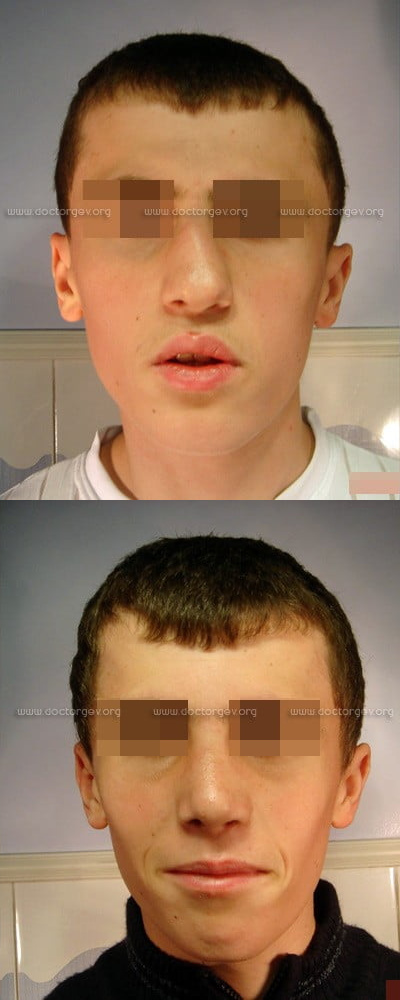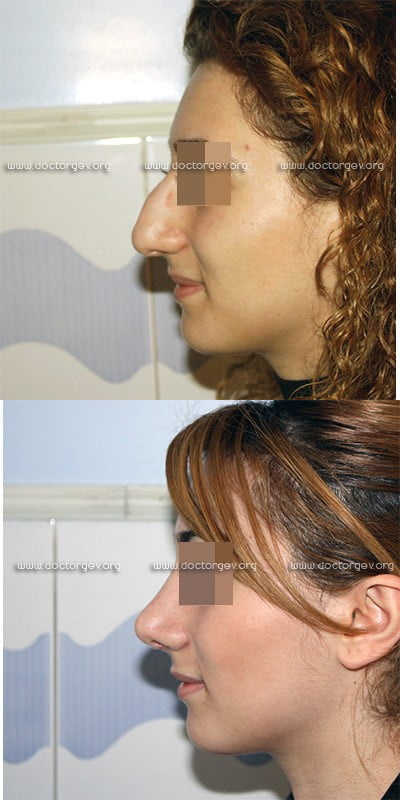

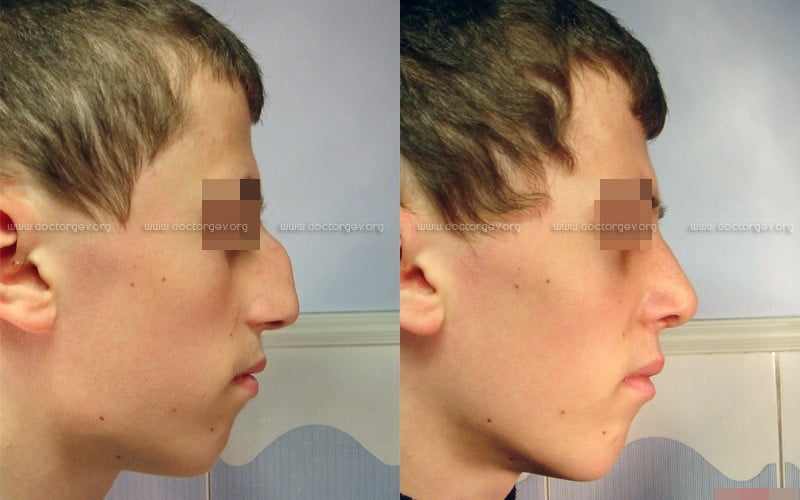
A young man approached me with a pronounced aesthetic deformity of the external nose. Due to large, sharp facial features and a massive profile, the patient experienced severe psychological discomfort. In addition, the examination confirmed my suspicion: excessive growth of cartilaginous structures led to a deviated internal septum, causing the young man to suffer from constant nasal congestion.
Anatomical Analysis “Before” Operation
Conducting a preoperative analysis of the patient’s profile, I identified the following key features:
- Nasal bridge: A large, sharp osteocartilaginous hump was observed in the middle and lower thirds. It created a sharp, angular break that dominated the face and visually weighed down its lower third.
- Nasal tip: Due to the severe drooping of the hump, the tip appeared droopy, and the nasolabial angle was excessively sharp. The nose had a characteristic hooked shape.
- Skin quality: The patient has fairly thin skin. For a surgeon, this is always a double responsibility. On one hand, thin skin contracts beautifully and allows for perfect definition of lines. On the other hand, it is unforgiving of mistakes, as the slightest irregularity of the cartilaginous or bony framework will be noticeable after healing. The work demanded absolute, jewelry-like precision from me.
Surgical Objectives and Course of the Operation
When planning male rhinoplasty, I am always guided by the rule of moderation: the nose should become neat but remain masculine. Under no circumstances should an excessive slope of the bridge or an over-rotated tip be allowed, to prevent the face from acquiring feminine features.
During the operation, I performed a delicate resection of the osteocartilaginous hump, completely smoothing out the sharp break and shaping a straight, strong masculine nasal bridge. In the next stage, I worked on the tip section: I elevated the nasal tip (performed its rotation) and slightly projected it forward (increased the projection), fixing it in an anatomically correct position. The angle between the lip and the nose became close to the ideal 90–95 degrees for men. As an internal step, I corrected the septum, restoring full nasal breathing to the patient.
Result “After” Operation
The result in the profile photo demonstrates striking yet maximally natural changes:
- Elimination of the defect: The sharp hump has completely disappeared. The line of the nasal bridge has become perfectly straight and noble.
- Balance of proportions: The nasal tip no longer droops during facial expressions; it is neatly defined and harmonizes with the forehead and chin. The patient’s face instantly refreshed, his gaze became more open and friendly, and the expression of perpetual frowning disappeared.
- Naturalness: The nose looks as if a surgeon never worked on it — it perfectly fits into the facial architectonics of the young man.
The patient has fully recovered, his nasal breathing has become completely free, and along with the new profile, self-confidence has returned to him.